Showing posts with label identity. Show all posts

25 June 2010

Integrated Resort 1 | Resorts World Sentosa

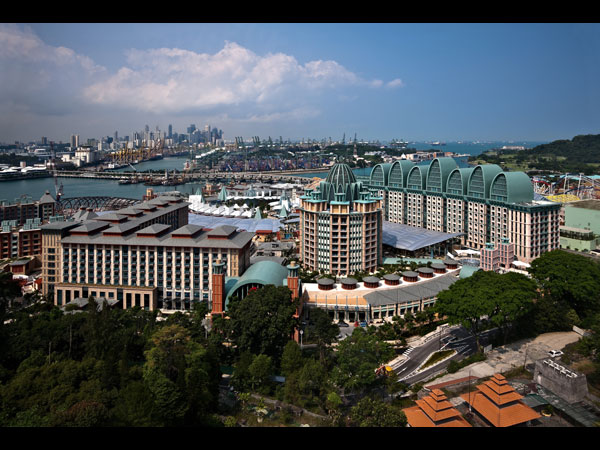
Resorts World Sentosa (called RWS around here because Singaporeans love acronyms) with the larger island of Sinapore in the background. All images of RWS from Slate's slideshow.

While the Passengers nervously watched USA and England keep alive their respective, overly optimistic quests for World Cup glory, Singapore welcomed the opening of its second den of iniquity integrated resort: Marina Bay Sands.  Some work remains to be done on the structure, especially the much anticipated Skypark atop the 55-story towers.  But this post piggybacks on an architectural write-up of the city-state's first integrated resort in Slate: Resorts World Sentosa. The project opened in time for the Chinese New Year in February and includes 1,740 hotel rooms spread over six locations, a maritime museum, convention and conference facilities, and loads of retail space, but these mostly serve as a fig leaf for the cash cow super casino.
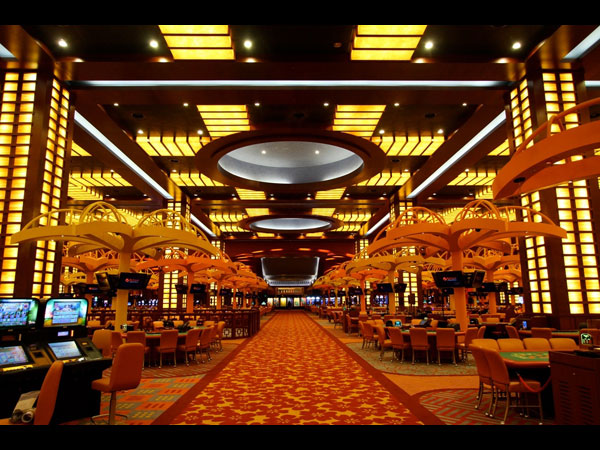
The gaming floor at RWS.

Traditionally the ruling classes party of Singapore have has looked down on gaming, but Macau is making money hand over fist from newly wealthy Chinese not allowed to gamble at home.  So Singapore decided to patronize all the punters who might patronize a casino  Only two casinos have been built and only as a part of larger euphemistically named integrated resorts.  The first project was located on Sentosa a small island to the south, even easier to control and far from most Singaporeans . Sentosa visitors pay S$3 to set foot on the island, and Singapore citizens must pay a S$100 (about 72 USD) admission to lose money inside the casino.  The gaming floor itself has been buried underground precisely to keep it away from public view.  Families should concentrate their excitement on the brand-name excitement above ground, a shiny new Universal Studios attraction.  Those Singaporeans unable to control their losses can be added to a blacklist and refused entry to the casino.

Slate's architectural critic Witold Rybczynski has a fair amount of praise for the 121-acre project designed by postmodern pioneers Michael Graves and Associates.  The principal and his firm have carried out something of a gesamtkunstwerk, an impressive total design effort extending from the hotel towers down to the flatware and the lamps in each hotel room.  This seems well within the capabilities of a firm that makes paper-towel holders for the discount retailer Target, but it hasn't been popular practice since the early twentieth century.

Micheal Graves Design Automatic Drip Coffeeemaker, available from Target.
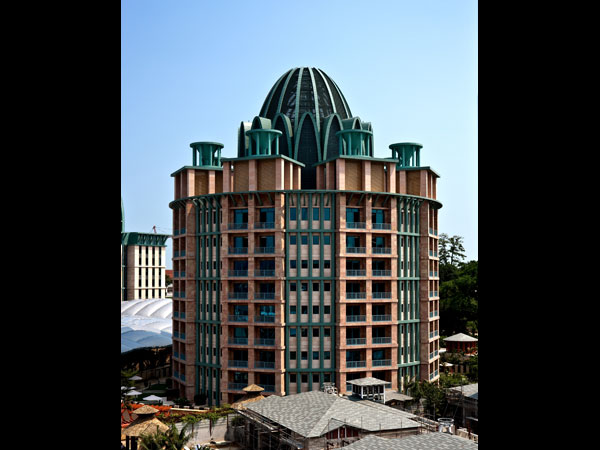
The high-end Cockfords hotel at RWS.

"Asians don't want to borrow from Western culture.  They want their own architecture.  Although they don't necessarily know what that is," says the condescending American Michael Graves.  Rybczynsky claims the Cockfords hotel was designed without the flourishes of Classicism that punctuate much of the architect's work.  This seems accurate if one ignores the green cupolas and refuses to see green rim encircling the top of the inhabitable floor as an overhanging cornice.  The design does bother to subtract any capitals from the extended pilasters that emerge to support the ring of oversized pedestals.  Also the name Cockfords does not necessarily suggest a Southeast Asian location.

Much of my hesitation to agree with Rybczynski stems from my dislike of the whimsical stunts that characterize Graves.  His play with classical devices and bold colors seems increasingly naff and bears some responsibility for some of the worst excesses of corporate architecture in the last thirty years.  However, I concede that the design probably does match the brief set forth by the patrons. This was not the first resort executed by Graves; he did Walt Disney World Swan, and his selection was probably a safe choice for Singapore.  Indeed the firm specializes in architectural fantasies so  it does not surprise that they built the blinders required to keep a supercasino super-clean.

09 June 2010

National Day Practice

Five F-16 fighter planes fly in formation across the sky in Singapore.

Practice has already begun for Singapore's National Day celebrations on 9 August.  The big event this year will not be held as usual at the National Stadium on Marina Bay because Singapore will turn 45 this year, and every five years the festivities take move nearby to the Padang, the green stretching along so many government offices and historic buildings.  It will displace the summer activities of the Singapore Cricket Club, and bleachers and lights are already being erected on the site.  The event features a heavy display of military hardware and special forces tactics, hardly a surprise for a nation that requires every young male citizen to do two years national service.

The flag of Singapore over the city's skyline.  One tower of the new Marina Bay Sands casino appears at the far right.

While I wrote the previous post on fashion label hansel, contingents of helicopters and F-16 fighter planes flew across the skyline view outside the Passenger's apartment and into the clouds gathering for an early afternoon downpour.  The helicopters carried a giant Singapore flag.

A closer view of the giant flag.  Click the picture for a larger image.

Want to learn about Singapore's national anthem? Want to know more about the parade? All the patriotism an expatriate needs lives on the NDP 2010 website.

30 May 2010

The Fourth Plinth Again | Yinka Shonibare

On 24 May 2010 Yinka Shonibare, a British artist raised in Nigeria, added his own naval-themed sculpture to the victorious monuments in Trafalgar Square.

The Mayor of London's office has commissioned another work for that one empty plinth in Trafalgar Square.  I mentioned the last work on the plinth outside the National Gallery in October,  Anthony Gormley's round-the-clock parade of ordinary people.  But last week the gently subversive Yinka Shonibare unveiled his addition to the Commonwealth's most famous square, an oversized knick-knack. His sculpture reproduces the Victory, the ship that Admiral Nelson commanded at the Battle of Trafalgar in 1805, except that the Nigerian-British artist has made all those majestic sails out of Dutch wax cloth, and he has built the entire miniature inside a bottle.

Yinka Shonibare's new sculpture for the so-called Fourth Plinth juxtaposed with Nelson's column in Trafalgar Square.  The portholes on the base of the work conceal fans that prevent condensation from building up in the bottle.

Nelson's Ship in a Bottle celebrates Britain's greatest naval triumph, one that opened at least a century of dominance and colonial enterprise, but Shonibare sealed the iconic ship within a polymer-glass bottle of extraordinary size, an adult could crawl through the mouth if the cork were removed.  The bottle's shape evokes a vessel for rum, a product of the slave and sugar industries in the West Indies and part of sailors' daily rations.  The ship-in-a-bottle composition overall evokes those quintessential Victorian hobbies of exactitude and possessiveness.  That European mindset which demanded that insects or stamps be captured, cataloged, and shelved paralleled European ambitions for planting a flag on every continent.

Nelson's Ship in a Bottle between the dome of the National Gallery and the spire of St Martin's-in-the-Fields.

However, those adventures brought the country into contact with a much wider world whose people now form an integral part of British society, particularly in multi-ethnic London.  The outrageous sails are of Dutch wax cloth, a type of fabric originally made in the Netherlands.  The sails with red-and-black patterns recall the batik designs of Malaysia and Indonesia that Dutch colonial merchants tried to manufacture and sell at home in patterns similar to those red anchors on white background.  Eventually, weak demand led the producers to try to hawk the surplus fabric in West Africa but as a conspicuously "European" product.  As British, and Dutch and American and Chinese, people and ships came and went around the world our totems of cultural and ethnic distinction became intermingled, and the process has not slowed down.

The front of Nelson's Ship showing the artist's initials "YSMBE" on the red bottle seal.

The setting of Trafalgar Square and its environs host a number of embassies and High Commissions from countries formerly part of the empire: South Africa, Uganda, New Zealand, Zimbabwe.  Yinka Shonibare himself is now officially part of all that confusion and the confused establishment.  He was made an MBE in 2004. The honour, which stands for Member of the Order of the British Empire, appears along with the artist's initials on the giant red seal of the bottle.  Mr. Shonibare loves to remind viewers of this accolade, and increasingly such globally minded innovators are essential for Britain's future.  As the artist says, such people "are still breathing precious winds into the sails of the United Kingdom."  Without them the accomplishments of the country would just be sealed up and collecting dust on the shelf.  
Additional photos after the jump.  Click the link at the lower left.

14 January 2010

A Happy Journey


A short demonstration of Singaporean transportation, manners, and humor.  The MRT system shuttles thousands of people around the island everyday on three (soon to be four) efficient, safe, and air-conditioned subway lines.  Of course, nothing here is really very old so the niceties of daily commuting have not been firmly entrenched.  To help, LCD televisions in various stations play the music video posted above to instruct straphangers about how to behave on the train or the bus.  It's a funny example of the nanny-state chiding visible around Singapore, but I wish London or New York occasionally tried to encourage a few more public-transport pleasantries.

The advisement features the Singaporean television actor Gurmit Singh in his role as Phua Chu Kang of "PCK Pte Ltd."  His gold chain, creepy mole, bushy wig, and yellow gumboots distinguish him as a Chinese contractor on the make, an uneducated type called an "Ah Beng" in Singlish.  Good to know that contractors are well regarded the world over.  Phua Chu Kang also warned Singaporeans about SARS (YouTube link) in 2003.

15 December 2009

Doors - Bali


This gate includes the Bahasa greeting "Selamat Datang" or "welcome."

People in Bali traditionally live in a family enclosure called a kampong (translated elsewhere in Bahasa-speaking regions as "village").  The compounds include numerous buildings for sleeping and cooking and farming, and though extended families often live together, they can spread out inside across multiple houses.  The Hindu heritage of Bali means that each kampong contains any number of shrines including a seat for a deity beside the principal entrance and usually a small sacred precinct inside.  Additionally, small offerings are placed daily in front of the doors of individual buildings. Here are some of the elaborate doorways that we saw around Ubud during our holiday.  Click the link at the bottom left to see all the pictures.


Many kampong entrances have been modified to accommodate Bali's ubiquitous motorbikes. A Chinese-inspired alternative to the more popular chair-style shrines can be seen at left.


A kampong portal wedged between shops along the road.


26 November 2009

Easy on the Turkey

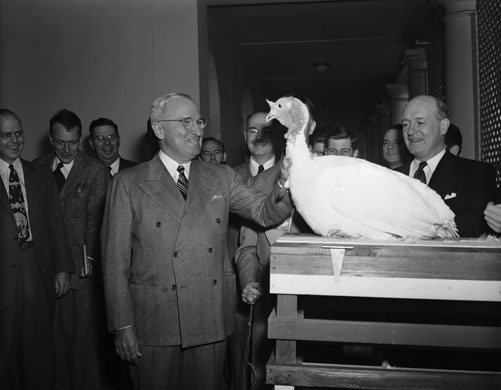
President Harry S Truman admiring a Thanksgiving turkey in 1950. Presidents have annually "pardoned" one of the delicious fowls since JFK. The Guardian has a slideshow of past presidents getting the bird.

Happy Thanksgiving, everyone! The Passengers wish we could be close to our nearest and dearest Americans to enjoy the holiday. Instead it's a normal working day in Singapore. We do get the gift of a public holiday tomorrow but not because of any navigationally challenged religious dissidents. It's the time for pilgrimage to Mecca for Muslims, Hari Raya Haji in Malay. The Passengers will do Thanksgiving with a number of expatriates and sympathetic Singaporeans on Sunday evening.

The Thanksgiving holiday in America provides a number of benefits. Firstly, the occasion is secular and can be enjoyed by anyone willing to participate. It seems especially fitting as a reminder of the immigrant beginnings of our national experiment. Along with the absence of creedal partisanship, Thanksgiving celebrations are hardly commercial, mostly an excuse to eat as much food as possible while spending time with family or friends. There is, of course, NFL football and a parade with marching bands to watch. Yes, Americans can only go so long without shopping. The day after Thanksgiving, also a public holiday, marks the opening of the Christmas shopping season ("Black Friday") with "doorbuster (link to this year's Wal-Mart circular)" offers to those who can wait in the cold for a big-box retailer to open at 5:00 AM. It's a rather crass coda to a national tradition, but Thanksgiving continues to play an important role in keeping the Christmas decorations and holiday jingles off the cultural landscape at least until December is a reasonable possibility. In Singapore the Christmas decorations went up before November, in part because of all the visiting dignitaries for the APEC Summit earlier this month.

13 October 2009

USA Soccer: Now some Better News

Go Wiz!

Contrary to yesterday's post, soccer is not unappreciated and unnoticed in the United States. In fact, the world's most popular spectator sport has finally found itself a place in world's largest entertainment market. Of course, soccer is not about to usurp college football or Nascar or the NFL from the nation's sporting liturgy, but the nation has slowly and steadily created opportunities to attract and retain passionate fans.

The most important effort has been the creation of Major League Soccer (MLS) in 1996. Major investments in America's domestic league began with ten teams in 1996 as an effort to capitalize on the enthusiasm generated by the 1994 World Cup finals held in the United States. Rather than splash out on top European or Latin American players in hopes of attracting huge crowds, as the ill-fated North American Soccer League did in the 1970's, the initial investors agreed to tight-fisted salary caps. Moreover, for the sake of nurturing domestic talent, i.e. the national team, each club was limited to carrying only five foreign-born players.

The experiment has undergone a number of growing pains. At first, many of the teams competed in giant stadiums designed for American football. Though these established venues were happy to lease out space in the spring and summer months, their over-sized dimensions meant that even a great turnout of 20,000 fans would bring a stadium to maybe 25% capacity. Now many franchises have sought out smaller, more intimate venues on college campuses or minor-league ballparks. LA and Columbus even have soccer-specific stadia.

Crew Stadium in Columbus, OH, offers a more fitting soccer venue than the city's 100,000-seat Ohio Stadium, aka "The Horseshoe."

Those early optics were not helped by the 1990's American sports trend of nicknaming teams for concepts and non-plural nouns. This trend produced head-scratchers like Tampa Bay Lightning in the NHL, but MLS took it to another level: Columbus Crew, San Jose Clash, Tampa Bay Mutiny. Most of these clubs were stationed in growing cities with only modest experience in pro sports, but Kansas City should have known better than to call its club KC Wiz. The name may reference "The Wizard of Oz," but a crowd chanting, "Go Wiz!" won't really intimidate the opposition. The team hastily became the Wizards in November 1996; Dallas Burn are now simply FC Dallas, and San Jose plays as Earthquakes.

The name change for Dallas taps into the current MLS trend: burnishing a side's soccer bonafides by imitating established club names in Europe. Incremental expansion has brought Real Salt Lake, Houston Dynamo, Toronto FC, and soon Philadelphia Union. Los Angeles even has Club Deportivo Chivas USA, an American offshoot of the established Guadalajara club and the area's Spanish friendly counterweight to flash LA Galaxy.

Stuart Holden of Amigo Energy (Houston Dynamo) challenges Seth Stammler of Red Bull (New York Red Bulls). Photo by Mike Stobe for Getty, 16 May 2009.

For fourteen seasons MLS has declined to buy their way to the top of the US sporting scene and settled instead for organic growth. This patience has helped to manage expectations and build a loyal fan base. The most publicized MLS story, LA Galaxy's purchase of celebrity footballer David Beckham in 2007, stood as a clear exception to the overall business model. The first franchise owners may have included heavyweights from the NFL and NHL, like Anschutz Entertainment Group (AEG) and the late Lamar Hunt, but they ventured forth with a rather conservative, even European business model. Notice the choice to accept the dependable revenue of shirt sponsors. It might be a common practice worldwide, but none of the major television sports in America does that. MLS knew they were starting a league that couldn't outplay or outdraw the English Premiership or Serie A for viewers or players. Sustainability had to trump theater.

12 October 2009

USA Soccer: First the Bad News

Update added below...

Mexico is in. England is in. So is Italy, but Turkey is out, and Portugal is looking shaky. Saturday featured worldwide sporting excitement as the major European football (soccer) leagues paused their schedule for the penultimate game of the World Cup group qualifiers. The Americans had to travel to Central America and defeat Honduras if they wanted a place at next summer's World Cup finals in South Africa. But did anyone care in the USA?

Yesterday, the Passengers awoke early in Singapore to join some of my countrymen watching college football courtesy of new-fangled Slingbox technology. For all you Britons, college football is the Saturday ritual of autumn across the Atlantic that involves millions of people gathering in stadiums with seating for over 100,000 people to watch university students play (American) football. A college football Saturday features more than fifty games, but only about twenty really matter. To partake of this rite in Singapore, twelve hours ahead of New York, passionate alumni must choose between the afternoon games starting at midnight or the evening games that start at 8:00 AM Sunday morning. This week was the highly anticipated contest between Florida and Louisiana State, but we were Big Ten alumni so we cared more about Michigan vs. Iowa.

As we watched, we noted the results from the earlier European qualifiers that occasionally scrolled across the bottom of the screen, along with other college scores and listings for the baseball playoffs, but none of us knew what country USA was playing nor what the game meant for their chance to qualify. The second half of the match in Honduras was still going when the Michigan game finished so we decided to change channels and cheer for our country. Unfortunately, no station available to us was carrying the game. That's right, despite 300+ channels of cable television available to one Michigan household, not one station bothered to broadcast a major international soccer match.

UPDATE (14 October 2009): The difficulty in finding the USA vs. Honduras game on TV was abetted by the Honduras federation, which under FIFA rules holds the television rights as the home side, deciding to sell the US broadcast rights to a company which elected to show the game on an obscure closed-circuit broadcast. Similar, yet stranger, circumstances restricted the moot England qualifier in Ukraine to a pay-per-view, online-only event. However, both blackouts ultimately resulted from the calculations of major media outlets that the expense of buying television rights and altering established broadcast schedules would not garner the advertising revenues or ratings to justify airing a World Cup qualifier.

02 October 2009

Können Sie mir helpfen?

The lost and found at Oktoberfest in Munich sorts all the mobile phones they receive according to manufacturer. Also the Fundbüro keeps an inventory of all its holdings using typewritten index cards. Let us both praise and mock great national traditions!

29 September 2009

York St Mary's - Five Sisters Installation

York St Mary's serves as an exhibition space for which the York Museums Trust regularly commissions site-specific artworks. The medieval parish church was deconsecrated in 1958.

Today was my last full day in York, a chance to catch up on a few last details of fieldwork before sending myself back towards London tomorrow morning. I made sure to drop by York St Mary's during a lunch break to photograph their current installation: Five Sisters.

The exhibition caught my eye because it uses the same nickname given to the towering transept facade inside the city's cathedral, York Minster. The artists Emma Biggs and Matthew Collings drew on the aesthetics of these five lancets to create their composition in mosaic and canvas painting. At the Minster, these soaring fields of glass were not decorated with representations of stories or saints, instead a mostly monochromatic scheme of grisaille glass was used to create geometric arrangements.

The glass in the so-called "Five Sisters" windows at York Minster was probably installed around 1250.

A detail of the "Five Sisters" glass patterns (via Traditional Building). Thirteenth-century stained glass compositions generally limited the use of saturated fields of red and blue compared to earlier Gothic tastes. Lighter colors and clearer glass admitted more light.

The mosaic along the nave of the church uses local fragments of pottery from the thirteenth and fourteenth century for tesserae. The homage to the Middle Ages becomes explicit, and the reuse of these shards calls attention to how succeeding generations treat objects of the past. These potsherds come from the York Museums Trust, and I assume that their collection has a surfeit of such remnants. Most preservation institutions are awash with historical bric-a-brac, only a small fraction of which could be put on display, only a fraction of which would interest the visiting public.

Emma Biggs & Matthew Collings, Five Sisters, 2009. Monochromatic paintings are placed at either end of the mosaic.

Detail of the tesserae in Emma Biggs & Matthew Collings, Five Sisters, 2009.

So what is a museum to do with all these shards? Similarly, how is a city like York supposed to manage its past after 2,000 years of continuous history? This installation allows artifacts to be both used and seen, and the venue itself, a decommissioned thirteenth-century parish church, came about through parallel circumstances. York has 19 surviving medieval parish churches, a more than adequate supply for the population's present Anglican needs. For artists, creative expressions and materials and techniques always arise out of earlier ideas and labor, and these creations must always contend with the "greats" of the past. In this case, Biggs and Collings place their borrowings front and center for everyone to consider.

25 September 2009

The Staffordshire Hoard

An especially deep plowing is suspected to have brought the buried treasure close to the surface this year.

An unemployed man with a metal detector in July unearthed the largest cache of Anglo-Saxon artifacts ever found in Britain. The lucky strike includes over 1500 objects, mostly of precious metals and gemstones, probably buried around AD 700 for safekeeping. Word of the discovery only went out today with an unveiling at the Birmingham Museum and Art Gallery. Since Terry Herbert first notified the portable antiquities scheme professional archaeologists have been working covertly in the field where the objects were found to try uncover more information about what took place there 1300 years ago. The exact location still remains secret and the Home Office is overseeing the excavations to keep out would-be looters.

Many of the precious objects were used to decorate swords, probably the spoils of warfare around the Midlands kingdom of Mercia. (from the BMAG flickr stream)

The overwhelming collection has been designated as "treasure" and thus belongs to the State. However, British museums will bid to take possession of the hoard. The final price will be divided between Mr. Herbert and the farmer who owns the field in which the find was made. These objects will keep curators, archaeologists, and art historians busy for years conserving and inspecting each piece for new historical insights into the so-called Dark Ages. The museum has great images of some of the treasure on flickr. The Guardian also has a slideshow, as does The Times.

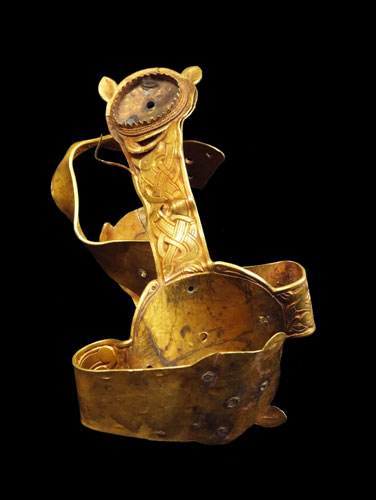
The twisted state of this cross decorated with interlace lead researchers to surmise it was plundered as gold booty. I assume the item was removed from the cover of a gospelbook.

Small, precious items allowed the ruling classes of Europe to carry and secrete their wealth (from the BMAG flickr stream).

02 July 2009

Fitting in at NMS


The National Museum of Singapore devotes itself to telling the history of Singapore starting from the fourteenth century. It also holds festivals that contribute to the state’s ongoing cultural life and hosts traveling exhibitions. Its mission seems a strange amalgam, especially as Singapore also has a visual arts museum and two institutions for cultural history. However, the National Museum can claim some apostolic exceptionalism since it took over duties from the colonial Raffles Library & Museum and its 1887 building by Sir Henry Edward McCallum.

The building was certainly not designed as a modern museum with intuitive traffic flow and flexible galleries. A modern overhaul began in 2003 and has created some inviting passages that harness the charm of the historic building while appending much-needed exhibition space. Almost all major museums in the post-War era have struggled to adapt to their staid homes. Old buildings psychically project legitimacy and gravitas, but many old museums were built for showing their collections as jumbles of knick-knacks and curiosities, not as a series of items requiring discreet displays for studying for each artifact.

Suzann Victor, Contours of a Rich Manoeuvre, each chandelier hangs 3m from bridge floor.

NMS has embraced their circumstances by commissioning artists to make site-specific installations in and around the building(s), both for the permanent collection and within their Art-On-Site series. A favorite addition has been Suzann Victor’s Contours of a Rich Manoeuvre, eight chandeliers that dangle above the bridge between the old and new buildings. The artist has updated a past symbol of luxury using replication and modern materials. But the chandeliers have been designed to swing back and forth in a number of configurations. The blend of past and present has not been left as a static and finished conflation.

S. Teddy Darmawan, Love Tank (The Temple), 2008-2009; roughly 3 x 5 x 8m

Another artist S. Teddy Darmawan has received temporary control over the main entryway. The Indonesian artist has stacked seven pink tanks (modeled on the M1 Abrams) underneath the museum’s iconic dome. Love Tank fills the height and breadth of the rotunda and crowds visitors immediately upon entrance. Ordinarily, a museum would consider such an installation unwelcoming and disruptive. Even MoMA, a museum that pays lip service to offering museum-goers provocative experiences, deemed it best to toy with visitors only after they pay $20. NMS, however, has a low porch over its entryway, and without the pile of tanks blocking the view arriving visitors would normally behold a steep staircase on the opposite side of a cramped rotunda. The architecture already required hiding the ticket counter to the left behind the low arcade, and the addition of S. Teddy D.’s installation helps declare this museum a place of experience and exploration rather than simple tourism. The riotous color scheme and lotus blossom patterning on the muscular masses of the tanks repeats the subversion of colonial architecture and self-serious/self-serving institutions. But if all that gets too antiestablishment, the museum does have an upscale restaurant (sound alert).

Love Tanks and the NMS dome with its original Victorian stained glass.

29 June 2009

Reworking Westminster

An aerial view of Westminster shows the abbey (foreground) with its present cap over the crossing of the nave and transept.

Big news for those of us who visit ancient churches: Westminster Abbey today announced plans for a gilded top over the church's crossing space. Currently, the building has a little stumpy finish in the middle of its roof because no previous architects, including Sir Christopher Wren, Nicholas Hawksmoor, and George Gilbert Scott, could come up with a structurally sound design within cost constraints. The new addition would sit atop the site of every English monarch’s coronation since William the Conqueror. The planned corona is part of a larger refurbishment of the abbey intended to add exhibition spaces along unused triforium level and amenities like a refectory.

As an art historian, I am of two, maybe more, minds about this development. My research depends upon accessing and visualizing medieval in their original state, but I fully recognize the many interests and activities that must compete for space inside an historic institution living in an historic building. Aside from ecclesiastical and tourist obligations, the church and its treasures must be maintained and secured. Add in an active music program, a world-class school, and a Poets’ Corner. It’s an absolute scrum for space and resources under a non-profit business model. These places must adapt in order to serve their mission and constituencies. Plus, the buildings I study often replaced earlier structures deemed inadequate or out-of-date. Renovation and replacement are constant in architecture as much as conversation and veneration.

King Edward the Confessor is interred in the old Westminster Abbey. Detail of the Bayeux Tapestry, c. 1077; Musée de la Tapisserie de Bayeux, Bayeux.

For the most part, England’s great churches have adapted over centuries. Clerics have prayed at Westminster since 960, and Edward the Confessor’s grand abbey appeared in the Bayeux Tapestry. The present building began under Henry III’s patronage in 1245, and numerous building campaigns since have lengthened the nave and added the western towers. Henry VII rebuilt the Lady Chapel in an ornate Perpendicular mode that became the model for the Palace of Westminster (Houses of Parliament) next door. Plus, the Suppression of the monasteries under Henry VIII threatened all of England’s abbeys with destruction.

The Swiss Re building by Lord Foster rises above the Tower of London.

Such history means I would be foolish to suggest that every medieval church should continue its eternal mission whilst frozen in a monument built for other times and demands. However, the new corona represents the first major alteration to the silhouette of any of England’s remaining medieval churches since a few nineteenth-century restorers heightened a few towers, like George Gilbert Scott at Bridlington, or pulled down rotting spires. This is renovation on a scale beyond installing fresh stained glass in a few lancets. It will further alter a London skyline that has evolved significantly in the last decade with the addition like the London Eye and the Swiss Re building, aka the Gherkin.

Additionally, the abbey has long enjoyed/endured a symbiotic relationship with the Crown. Architectural historians have long noted the building’s physical similarities and symbolic correspondence to Reims cathedral, the coronation church of the French kings. The Dean and Chapter who now oversee the church have asked for public comments on its proposed developments, but Prince Charles, a notorious critic of modern architecture, would be the first monarch crowned under the new structure. The new corona, Latin for “crown,” will intensify and reassert the connection between Church and State in Britain, and the Royals will continue to have some say over the appearance of Westminster Abbey.

The space in front of the high altar has seen the crowning of every English monarch since Edward I.

28 June 2009

Saturday in East Singapore

This 328 location, in a traditional Peranakan shophouse building, attracts diners hungry for Laksa.

Saturday featured a very successful outing. The Passengers ventured out with a few Americans to Katong, a neighborhood in East Singapore traditionally home to Peranakans (Chinese families who have long dwelled in the Straits region). These streets gave birth to a spicy noodle and coconut soup called Laksa. We perched atop small plastic stools facing onto East Coast Road and ate at one of the areas's best known stalls (above). We also strolled by the Sri Senpaga Vinayagar temple (below). Chinese have lived around here for centuries, but this Hindu monument on Ceylon Road was built in 1875.


Three military helicopters cross the sky on exercises for the National Day parade 9 August.

Next, we hopped in a cab and made for the East Coast Lagoon Food Village where we sat at seaside picnic tables with pitchers of Tiger beer and a great view of the current maritime parking lot (below). The Food Village is another of the open-air clusters of food stalls, or hawker centres, found throughout Singapore. We heaped up plates of satay, stingray, and carrot cake. I took pictures of a couple interesting signs. Good food. Good chat. Good views.


26 June 2009

Primary Care Primer

Wherever I travel abroad and no matter the political situation in the United States, talk about life in my country invariably circle around to America’s labyrinthine system of health care. Generally, I welcome the chance to explain life in those United States to any willing listener/reader. I hope, probably naively, that conversations about real experiences help everyone to humanize and understand a world full of social caricatures. Most of the perceived deficiencies of the United States (or any country, really) are actually peculiarities, like two-party politics or SUV's. Usually, I feel I can give some apology and for my nation's various quirks that makes America less cartoonish. However, in discussions about the American health care system I have yet to find myself an apology, and every year our medical arrangements become even more “perverse and baffling,” whether measured by individual stories or systemic statistics. Simply put, a major illness can carry catastrophic and ruinous costs, and medical insurance provides only a modicum of security.

Americans understand very little about how they pay the doctors, hospitals, and pharmacies that provide their medical care. This has contributed greatly to inaction against the system’s incentives and inefficiencies. It also explains why health care reform becomes a political rallying cry about once a decade. For those abroad who want to know what Americans live through when they get sick and for those Americans who wonder why it has come to this and how to fix it, I have a sampling of the really informative and provocative journalism (bold links) that has been generated by the current clamor for medical coverage.

Presently, dissaffection has reached a level where Americans are actually willing to pay increased taxes for adequate health care coverage, but we are still fearful of what change could mean. As always, the Economist do summaries of the existing situation really well. For a detailed look at the difficulties in containing health care costs, read Atul Gawande's "The Cost Conundrum," a New Yorker piece cited by the Obama administration. Dr. Gawande also wrote an insightful, and more encouraging, look in 2008 about how various European nations built their health care systems. For a more global perspective in providing patient care, listen to NPR's All Things Considered's examinations of Taiwan and Japan for Frontline.

Gawande's assumption that Americans will probably want to keep insurance as the mechanism for paying medical bills has proved accurate given the current discussion of a so-called "public option" for medical insurance. Robert Reich and Paul Krugman both write repeatedly about the economics of how a public option might control costs. Of course, a badly designed public option has serious risks.

Of course, all of this political chit-chat rides the daily shifts of opinions and optimism, but much of America appears to be debating and thinking about what they want in the health care. I only hope that what we want will be good for us, too. Anyone else read a good story or study about American health care? Click on "comments" below and clue us in.

Update (29 June 2009): Columnist David Brooks delivered an incredibly astute assessment of the legislative machinations toward health care reform a couple weeks ago. It's one of the cleverest passages of non-partisan political commentary I have read in some time.

16 June 2009

Asian Mystique: Literary or Lurid?

Jean-August-Dominique Ingres-Montauban, detail of Une Odalisque, 1814; Musée du Louvre, Paris.

A new book, The East, the West, and Sex: A History of Erotic Encounters, has hit the shelves. The author Richard Bernstein, a writer for the International Herald Tribune, explores the various attractions and abuses within relationships of Eastern and Western partners, particularly White men and Asian women. I have not read the book, but I wish him all the best at an hopefully honest attempt to crack open and sort through a can of worms that probably also contains botulism. This a topic that I anticipate will elicit visceral reviews and responses.

The cover features a detail from the famous Une Odalisque, and the image certainly packages up several issues that make discussions like Bernstein's so fraught. The nude Ingres created for the 1819 Paris Salon falls into a category of images art historians label as "Orientalist." Paintings like this, ostensibly a rendering of a harem girl, latched onto exotic and salacious aspects of Near Eastern culture to serve up titillation to Western viewers, whether factual or not. These compositions had a place alongside travelogues and a larger oeuvre of depictions that created a stereotypical East in Western minds, full of exotic morals and behaviors. This was the Orient of harems and geishas. Numerous scholars, following Edward Said's post-colonial treatise Orientalism, have shown how this caricature of a sexually available, and morally backward, East gave justification to colonists who saw the territory as open to military and economic penetration. Such attitudes of the East as populated by people "not like us" abetted the dehumanizing absuses of colonialism. Unfortunately, some present discussions of foreign relations have really not moved too far along. A book about sexual encounters between East and West would examine this dysfunctional relationship at its most personal levels.

For a good perspective on the present day, check out Laura Miller's cogent review of Bernstein for Salon. She acknowledges that both men and women can consciously choose a foreign-born partner but remains aware that prevailing circumstances usually don't favor Eastern women. Most importantly, she points out the central fallacy in the myth that Western men treat their chosen partners better than Eastern men do. Such allegedly superior mores largely derive from the ongoing struggles of Western women for greater respect and equality, and men who head East for female companionship could be considered runaways from such moral constraints. Her critique helps to explain the perception of injustice that often arises when people opt out of the supposed pool of acceptable partners. I heard one vivacious white woman in Singapore sum up her frustration with the local dating scene by declaring that no white men asked her out because they were all looking for "a taste of Asia."

However strongly such beliefs are held, some evidence exists to suggest that the predilection of white men for East Asian women constitutes more of a niggling anecdote than an actual phenomenon. Social experiments by Ray Fishman suggested that white men overall (in America) did not exhibit any racial preferences in their attractions to the opposite sex. Plus, new patterns of migration have greatly diminished the specter of colonialism. For example, how should sexual interactions involving well integrated children of immigrants or expatriates be classified? These couples might fit an White + Asian phenotype, but does this distinction become irrelevant when both partners share in the cultural principles of the adopted society? My experience has included multiple examples of mixed couples, including white chaps with Asian women, who enjoy relationships based on mutual attraction and affection. Awful stereotypes, like "lecherous, overweight Western sex tourist" or "gold digging Asian," surely represent an equally narrow and dangerous way to perceive the world. It's the plank in my own eye that I should worry about most. Another reminder to remain patient and generous when bedding down in another land.

Update (1 July 2009): Johann Hari has added a review of Bernstein for Slate, and ballet dancer/author Toni Bentley read the book for the New York Times. Also the vivacious white woman mentioned earlier had a second date with a nice chap last week.

14 May 2009

Marmite Ad

I have spent very little time in London during this trip through England. However, while returning from Leeds to the Home Counties, I traveled along the Victoria line to get myself south of London. On the journey I spied this clever, kinematic advertisement overhead in my Tube carriage.

For the uninitiated, Marmite has been a staple of British life for over one hundred years, the dark, sticky spread made from brewer’s yeast has provided cost-efficient loads of B vitamins and salt to the public for decades, preferably spread thinly across toast at breakfast. I find it a fascinating taste and a great aid against hangovers, but many native Britons find the food’s texture, concept, and taste revolting. Australians vainly promote Vegimite to Marmite haters as a milder alternative. I can hardly tell the difference between the two, and the argument seems only to concern the Poms vs. those "from a Land Down Under." Americans generally abhor the product in all its forms.

Despite, or perhaps because of, this strong taste and distinctive smell Marmite inhabits British culture as both a comfort food and a looking glass into British culture. The company began in Burton-on-Trent, where the English produced many a fine beer and discarded yeast was available in great volumes. Iconic jars of Marmite also provided part of soldiers’ rations in both World Wars, serving vitamins and salt to expeditionary troops. (Read Mark Kurlansky for more about armies’ unyielding need for salt.) The Marmite label and packaging have changed very little over the years, maintaing these associations, and the cheap prices and slight punitive flavor probably reminds Britons of the make-do-and-mend spirit that sustained the country through rationing, civil unrest, and gray winters.

However, Marmite has been expanding their brand in recent years, putting their flavor and imprimatur on potato chips and related snack foods, like cashews. Plus, they have developed a number of brand partnerships and alternative flavors for those who want their yeast extract to taste just a little different. But trust me, the Marmite flavor trounces both champagne and Guinness.

Now I am off on a thirteen-hour flight to Singapore.

06 May 2009

Life in the North Yorkshire Dales


I had to cross several time zones, but I have finally made it back to the Midwest. Actually, these days I am even further from the Midwest than usual. I am in Ripon in North Yorkshire to do research on the big stone church here. The city is an historic market town on the River Skell; the monastery that later became Ripon Cathedral goes back to the seventh century. However, most of the urban fabric, including the market place, dates only back to the eighteenth century.

It's a remote place by English standards. There is no train station; I arrived by bus from Harrogate. The nearest university is probably aways south in Leeds or York. Both of those are considered relatively new institutions. The University of Leeds is barely one hundred years old. Again, English standards. Historically, Ripon arose from agriculture and livestock around the Yorkshire Dales. Now much of its economy relies on tourism. In addition to historic charm Ripon has a well known racecourse. The city lies between the Yorkshire Dales and the North Yorkshire Moors National Parks, which makes it a good stop for literary folks chasing Brontes or Shelley or even James Herriot.

The tourism means the town has plenty of places to eat, but Ripon does not really bustle. I had to visit three pubs before I found one serving food after 7:30 tonight. Hotels are plentiful, but none of the major chains operate here. They are down in Harrogate with the International Centre. The agricultural history and its separation from the British mainstream give it a familiar feel to someone who grew up in the rural Midwest. The shops here are provincial. Even if daily newspapers and television link everyone into the latest fashion and music, those cultural touchstones don't travel very well. Urban fabrics and urban sounds are not quite suited to the lifestyle here. Likewise, the food has been good so far, but it is based around an agrarian diet where meat is plentiful and local, not a convergence of multiple cultures. I had my second pie (fish) for dinner in as many days. I am also on a first-name basis with several of the hotel staff already, and the library has kept a pile of books waiting for my return tomorrow. They are not carefully catalogued on a reserve shelf. The librarian simply stacked them atop the Help Desk with a note announcing my return tomorrow. Occasionally, locals ask why I left New York to spend a week here. I came here for work, but all those hometown qualities mean I don't go stir crazy here. I try to concentrate on the niceties that are cultivated by a more static environment. A preacher once described his hometown to me. "It's a great place to be from," he intoned. It's not glamorous, but being from somewhere teaches a lot about how to live somewhere.