Showing posts with label museums. Show all posts

11 April 2011

Ai Weiwei: disappeared provocateur

Video from newyorker.com by Alison Klayman.

On or around 3 April 2011 the internationally known Chinese artist Ai Weiwei was detained by authorities in his home country. Ai was seized at Beijing's airport, and the crackdown also ransacked his Beijing studio and also detained his artist wife Lu Qing and assistants, though they were released quickly. As of writing, the prolific multimedia artist remains missing, though a state news service briefly published a story that he is under investigation for "economic crimes." China's foreign ministry insists this has nothing to do with his previous activism.

Ai Weiwei proffering ceramic sunflower seeds in the Turbine Hall of Tate Modern. Image from the Guardian.
The artist, most recently known in Britain for his stunning exhibition of 100 million hand-painted porcelain sunflower seeds spread across the Turbine Hall of Tate Modern, has been an agent provocateur both inside and outside of China. His art is rarely overtly political, more playful actually, but he has spoken out frequently against injustice in his home country. 

The public nature of Ai's protests against police brutality and his recruitment of citizen activists to investigate shoddy construction standards in Sichuan province, where countless school buildings tragically crumbled in a 2008 earthquake, have made Ai's disappearance a prominent international incident. For more on the artist, his work, and his opinions, see the profile published by Evan Osnos in the New Yorker last year. The video at top shows images of the studio and a contentious confrontation with local police.

Examples from Ai Weiwei's Circle of Animals/Zodiac Heads. Image from NY Times.
 Update (5 May 2011): The artist remains in detention, and Chinese authorities have said little else about his imprisonment. However, a series of Ai Weiwei sculptures can be seen outside the Plaza Hotel in Manhattan, and they will be on display in the courtyard of Somerset House in Central London from 12 May. Several talks about the travails of artists working in China have been scheduled in conjunction with the London exhibition.

22 March 2011

Art Trivia!

Detail of One Year by George Maciunas, 1973-74; Museum of Modern Art, New York. Image from PopRally website.
Several of my passions in life have finally collided. If I was still living in New York, I would definitely go to this next Tuesday at MoMA.
PopRally is pleased to present PopQuiz, an evening of art-related trivia held in conjunction with MoMA's Contemporary Art from the Collection exhibition. Teams of up to six people register upon check-in to participate in three rounds of art trivia and games, with winners taking home prizes such as MoMA memberships. Hosted by Ryan McNamara, whose work was recently featured in MoMA PS1's Greater New York exhibition, this event also features a DJ set by Tanlines.
Alas, I will console myself with my usual Singapore Tuesday trivia.

29 June 2010

Protect Me from the Tragedy of Culture


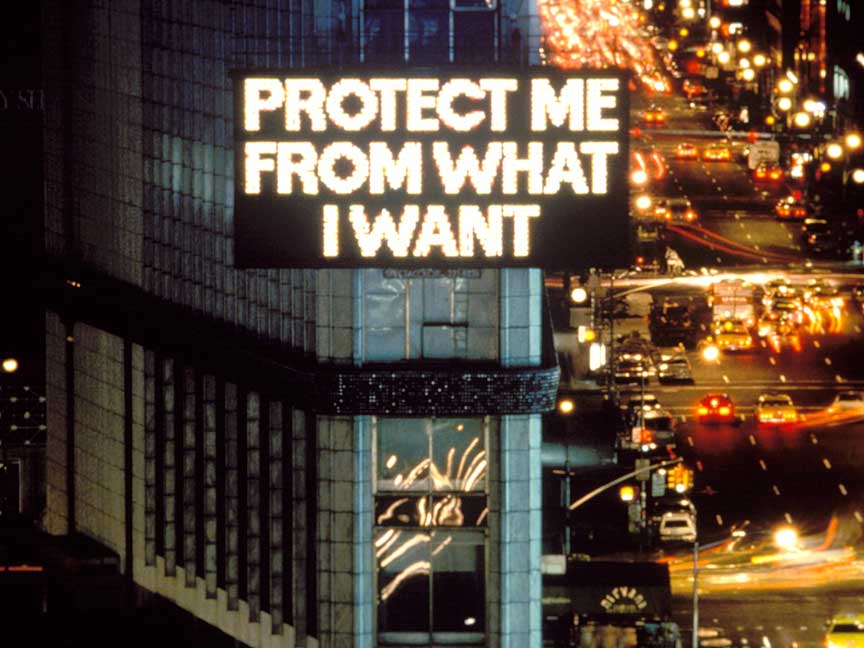
Artist Jenny Holzer put up an illuminated billboard in Times Square in 1986 as part of her well known "Survival" series.  The imperative "Protect me from what I want" called attention to the intrusion of advertising, the commercial exploitation of public space, and our helplessness within the situation.  Now appreciators of art can own that experience for themselves and support the Whitney Museum by purchasing a pair of Keds sneakers.  Get them at Bloomingdale's starting 8 July, $75 for high tops, $70 for low tops.  As Tom Scocca pointed out, buying shoes emblazoned with messages about mass market consumption prices are essentially announcing that you, the consumer, paid a mark-up of 100%.


The Holzer designed sneakers.  Image from the New York Times.

Welcome to the 25th anniversary celebration of American consummerism critique.  Buy your special deluxe edition of Don DeLillo's White Noise now.  Maybe we would do better to retreat all the way back to the nineteenth century and the foundational sociology of Georg Simmel on the "tragedy of culture." I may get to when I finish listening to Naomi Klein on my iPod.

29 September 2009

York St Mary's - Five Sisters Installation

York St Mary's serves as an exhibition space for which the York Museums Trust regularly commissions site-specific artworks. The medieval parish church was deconsecrated in 1958.

Today was my last full day in York, a chance to catch up on a few last details of fieldwork before sending myself back towards London tomorrow morning. I made sure to drop by York St Mary's during a lunch break to photograph their current installation: Five Sisters.

The exhibition caught my eye because it uses the same nickname given to the towering transept facade inside the city's cathedral, York Minster. The artists Emma Biggs and Matthew Collings drew on the aesthetics of these five lancets to create their composition in mosaic and canvas painting. At the Minster, these soaring fields of glass were not decorated with representations of stories or saints, instead a mostly monochromatic scheme of grisaille glass was used to create geometric arrangements.

The glass in the so-called "Five Sisters" windows at York Minster was probably installed around 1250.

A detail of the "Five Sisters" glass patterns (via Traditional Building). Thirteenth-century stained glass compositions generally limited the use of saturated fields of red and blue compared to earlier Gothic tastes. Lighter colors and clearer glass admitted more light.

The mosaic along the nave of the church uses local fragments of pottery from the thirteenth and fourteenth century for tesserae. The homage to the Middle Ages becomes explicit, and the reuse of these shards calls attention to how succeeding generations treat objects of the past. These potsherds come from the York Museums Trust, and I assume that their collection has a surfeit of such remnants. Most preservation institutions are awash with historical bric-a-brac, only a small fraction of which could be put on display, only a fraction of which would interest the visiting public.

Emma Biggs & Matthew Collings, Five Sisters, 2009. Monochromatic paintings are placed at either end of the mosaic.

Detail of the tesserae in Emma Biggs & Matthew Collings, Five Sisters, 2009.

So what is a museum to do with all these shards? Similarly, how is a city like York supposed to manage its past after 2,000 years of continuous history? This installation allows artifacts to be both used and seen, and the venue itself, a decommissioned thirteenth-century parish church, came about through parallel circumstances. York has 19 surviving medieval parish churches, a more than adequate supply for the population's present Anglican needs. For artists, creative expressions and materials and techniques always arise out of earlier ideas and labor, and these creations must always contend with the "greats" of the past. In this case, Biggs and Collings place their borrowings front and center for everyone to consider.

02 July 2009

Fitting in at NMS


The National Museum of Singapore devotes itself to telling the history of Singapore starting from the fourteenth century. It also holds festivals that contribute to the state’s ongoing cultural life and hosts traveling exhibitions. Its mission seems a strange amalgam, especially as Singapore also has a visual arts museum and two institutions for cultural history. However, the National Museum can claim some apostolic exceptionalism since it took over duties from the colonial Raffles Library & Museum and its 1887 building by Sir Henry Edward McCallum.

The building was certainly not designed as a modern museum with intuitive traffic flow and flexible galleries. A modern overhaul began in 2003 and has created some inviting passages that harness the charm of the historic building while appending much-needed exhibition space. Almost all major museums in the post-War era have struggled to adapt to their staid homes. Old buildings psychically project legitimacy and gravitas, but many old museums were built for showing their collections as jumbles of knick-knacks and curiosities, not as a series of items requiring discreet displays for studying for each artifact.

Suzann Victor, Contours of a Rich Manoeuvre, each chandelier hangs 3m from bridge floor.

NMS has embraced their circumstances by commissioning artists to make site-specific installations in and around the building(s), both for the permanent collection and within their Art-On-Site series. A favorite addition has been Suzann Victor’s Contours of a Rich Manoeuvre, eight chandeliers that dangle above the bridge between the old and new buildings. The artist has updated a past symbol of luxury using replication and modern materials. But the chandeliers have been designed to swing back and forth in a number of configurations. The blend of past and present has not been left as a static and finished conflation.

S. Teddy Darmawan, Love Tank (The Temple), 2008-2009; roughly 3 x 5 x 8m

Another artist S. Teddy Darmawan has received temporary control over the main entryway. The Indonesian artist has stacked seven pink tanks (modeled on the M1 Abrams) underneath the museum’s iconic dome. Love Tank fills the height and breadth of the rotunda and crowds visitors immediately upon entrance. Ordinarily, a museum would consider such an installation unwelcoming and disruptive. Even MoMA, a museum that pays lip service to offering museum-goers provocative experiences, deemed it best to toy with visitors only after they pay $20. NMS, however, has a low porch over its entryway, and without the pile of tanks blocking the view arriving visitors would normally behold a steep staircase on the opposite side of a cramped rotunda. The architecture already required hiding the ticket counter to the left behind the low arcade, and the addition of S. Teddy D.’s installation helps declare this museum a place of experience and exploration rather than simple tourism. The riotous color scheme and lotus blossom patterning on the muscular masses of the tanks repeats the subversion of colonial architecture and self-serious/self-serving institutions. But if all that gets too antiestablishment, the museum does have an upscale restaurant (sound alert).

Love Tanks and the NMS dome with its original Victorian stained glass.

29 June 2009

Reworking Westminster

An aerial view of Westminster shows the abbey (foreground) with its present cap over the crossing of the nave and transept.

Big news for those of us who visit ancient churches: Westminster Abbey today announced plans for a gilded top over the church's crossing space. Currently, the building has a little stumpy finish in the middle of its roof because no previous architects, including Sir Christopher Wren, Nicholas Hawksmoor, and George Gilbert Scott, could come up with a structurally sound design within cost constraints. The new addition would sit atop the site of every English monarch’s coronation since William the Conqueror. The planned corona is part of a larger refurbishment of the abbey intended to add exhibition spaces along unused triforium level and amenities like a refectory.

As an art historian, I am of two, maybe more, minds about this development. My research depends upon accessing and visualizing medieval in their original state, but I fully recognize the many interests and activities that must compete for space inside an historic institution living in an historic building. Aside from ecclesiastical and tourist obligations, the church and its treasures must be maintained and secured. Add in an active music program, a world-class school, and a Poets’ Corner. It’s an absolute scrum for space and resources under a non-profit business model. These places must adapt in order to serve their mission and constituencies. Plus, the buildings I study often replaced earlier structures deemed inadequate or out-of-date. Renovation and replacement are constant in architecture as much as conversation and veneration.

King Edward the Confessor is interred in the old Westminster Abbey. Detail of the Bayeux Tapestry, c. 1077; Musée de la Tapisserie de Bayeux, Bayeux.

For the most part, England’s great churches have adapted over centuries. Clerics have prayed at Westminster since 960, and Edward the Confessor’s grand abbey appeared in the Bayeux Tapestry. The present building began under Henry III’s patronage in 1245, and numerous building campaigns since have lengthened the nave and added the western towers. Henry VII rebuilt the Lady Chapel in an ornate Perpendicular mode that became the model for the Palace of Westminster (Houses of Parliament) next door. Plus, the Suppression of the monasteries under Henry VIII threatened all of England’s abbeys with destruction.

The Swiss Re building by Lord Foster rises above the Tower of London.

Such history means I would be foolish to suggest that every medieval church should continue its eternal mission whilst frozen in a monument built for other times and demands. However, the new corona represents the first major alteration to the silhouette of any of England’s remaining medieval churches since a few nineteenth-century restorers heightened a few towers, like George Gilbert Scott at Bridlington, or pulled down rotting spires. This is renovation on a scale beyond installing fresh stained glass in a few lancets. It will further alter a London skyline that has evolved significantly in the last decade with the addition like the London Eye and the Swiss Re building, aka the Gherkin.

Additionally, the abbey has long enjoyed/endured a symbiotic relationship with the Crown. Architectural historians have long noted the building’s physical similarities and symbolic correspondence to Reims cathedral, the coronation church of the French kings. The Dean and Chapter who now oversee the church have asked for public comments on its proposed developments, but Prince Charles, a notorious critic of modern architecture, would be the first monarch crowned under the new structure. The new corona, Latin for “crown,” will intensify and reassert the connection between Church and State in Britain, and the Royals will continue to have some say over the appearance of Westminster Abbey.

The space in front of the high altar has seen the crowning of every English monarch since Edward I.

04 June 2009

Summer in the City


The Guardian just published a new travel feature on New York City with ten destinations to help visitors enjoy the summer weather and escape the oppression of warm asphalt and sun-baked dumpsters. The suggestions should encourage both NYC residents and those who need another reason/excuse to visit. I now want to visit Wave Hill Gardens, especially now that I finally have friends living in the Bronx. I would like to add a few endorsements and addenda to fill out the Guardian's well-conceived recommendations. The numbering below corresponds to the newspaper's list.


1. Water Taxi Beach: I am glad this summer institution is expanding, but the original Queen's location with its view of the Midtown skyline will be hard to beat. Speaking of beats, to make the most of a foray into this outer borough, go dancing in the afternoon sunshine at PS 1's Warm Up. The avant garde outpost of MoMA deploys its Young Architects Program to transform its courtyard into a recreational space where families and hipsters and locals enjoy world-class DJ's every Saturday throughout the summer. If dancing doesn't suit you, try the nearby Noguchi Museum and its gardens (above).


5. Rooftop Bars: I commend the Guardian for promoting a low-key, inexpensive alternative over the more outrageous rooftop bars of the city. I will add a this recent guide courtesy of New York magazine. I support all trips to Koreatown for a laid-back venue, and Bookmarks, atop the Library Hotel, offers an urbane spot to watch the flicker of city lights. I will take that crowd above the painfully hip choking the Meatpacking District any day. The Metropolitan Museum also has a roof (above) overlooking Central Park with drinks available.


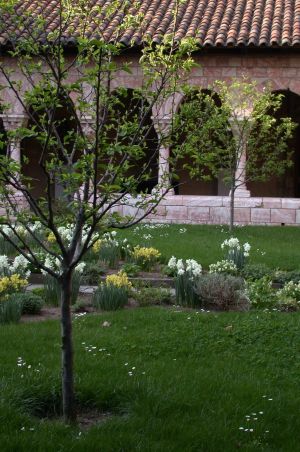
7. The Cloisters: I am very proud that the Metropolitan Museum's medieval annex in Fort Tryon Park garnered a mention, not least because they have kept me in beer for now three years running. Garden Days at the Cloisters happen this weekend (6, 7 June) for all who appreciate the museum's stunning displays of plants and historical botany. I recommend the Cloisters to all who will listen, but I further advise everyone to expand your visit into a mini-break from Manhattan with lunch or brunch on the patio of New Leaf Café, also in Fort Tryon Park.

8. Brooklyn Botanic Garden: The New York Botanical Garden gets my pick over the smaller, more crowded BBG. Still, this garden makes for a nice day out, especially when combined with the fascinating and charming Brooklyn Museum (see McKim, Mead, and White façade atop the post, from Josh and Josh) and the idles of Prospect Park. King's County (i. e. Brooklyn) has built for itself a number of cultural institutions that would be nationally renown if it wasn't for those pesky, august bulwarks elsewhere in the city. For a look into Brooklyn's effortless appeal to families who somewho maintain adult lifestyles, visit the museum on a Target First Saturday.

And those are a few of my suggestions for how to take the New York Summer to 11. Don't worry, my nostalgia should pass quickly. The Passengers are spending this weekend stretched out on the Indonesian beaches of Bintan.