25 June 2010

Integrated Resort 1 | Resorts World Sentosa

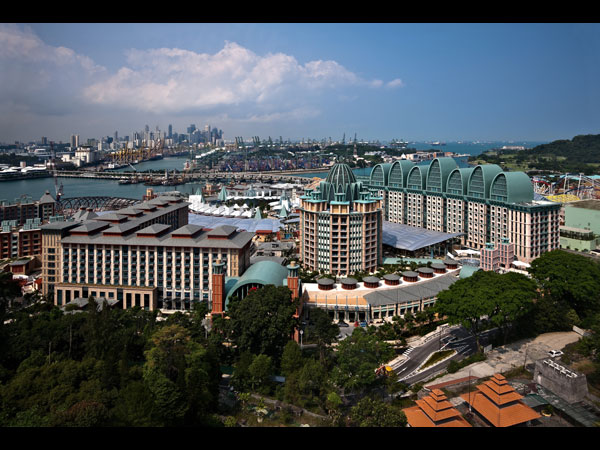
Resorts World Sentosa (called RWS around here because Singaporeans love acronyms) with the larger island of Sinapore in the background. All images of RWS from Slate's slideshow.

While the Passengers nervously watched USA and England keep alive their respective, overly optimistic quests for World Cup glory, Singapore welcomed the opening of its second den of iniquity integrated resort: Marina Bay Sands.  Some work remains to be done on the structure, especially the much anticipated Skypark atop the 55-story towers.  But this post piggybacks on an architectural write-up of the city-state's first integrated resort in Slate: Resorts World Sentosa. The project opened in time for the Chinese New Year in February and includes 1,740 hotel rooms spread over six locations, a maritime museum, convention and conference facilities, and loads of retail space, but these mostly serve as a fig leaf for the cash cow super casino.
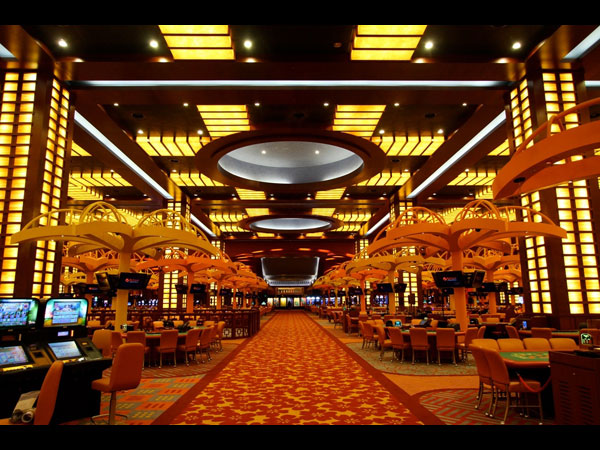
The gaming floor at RWS.

Traditionally the ruling classes party of Singapore have has looked down on gaming, but Macau is making money hand over fist from newly wealthy Chinese not allowed to gamble at home.  So Singapore decided to patronize all the punters who might patronize a casino  Only two casinos have been built and only as a part of larger euphemistically named integrated resorts.  The first project was located on Sentosa a small island to the south, even easier to control and far from most Singaporeans . Sentosa visitors pay S$3 to set foot on the island, and Singapore citizens must pay a S$100 (about 72 USD) admission to lose money inside the casino.  The gaming floor itself has been buried underground precisely to keep it away from public view.  Families should concentrate their excitement on the brand-name excitement above ground, a shiny new Universal Studios attraction.  Those Singaporeans unable to control their losses can be added to a blacklist and refused entry to the casino.

Slate's architectural critic Witold Rybczynski has a fair amount of praise for the 121-acre project designed by postmodern pioneers Michael Graves and Associates.  The principal and his firm have carried out something of a gesamtkunstwerk, an impressive total design effort extending from the hotel towers down to the flatware and the lamps in each hotel room.  This seems well within the capabilities of a firm that makes paper-towel holders for the discount retailer Target, but it hasn't been popular practice since the early twentieth century.

Micheal Graves Design Automatic Drip Coffeeemaker, available from Target.
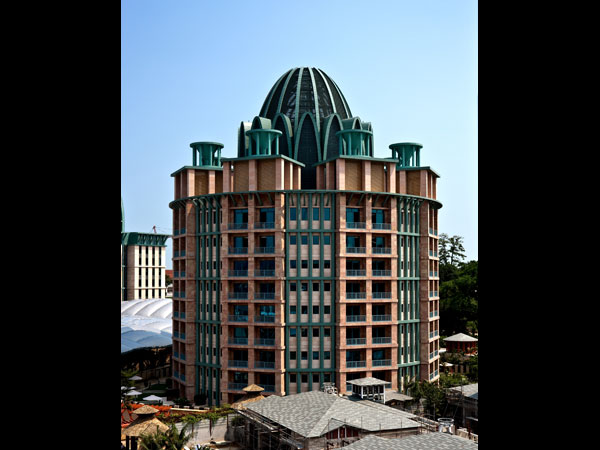
The high-end Cockfords hotel at RWS.

"Asians don't want to borrow from Western culture.  They want their own architecture.  Although they don't necessarily know what that is," says the condescending American Michael Graves.  Rybczynsky claims the Cockfords hotel was designed without the flourishes of Classicism that punctuate much of the architect's work.  This seems accurate if one ignores the green cupolas and refuses to see green rim encircling the top of the inhabitable floor as an overhanging cornice.  The design does bother to subtract any capitals from the extended pilasters that emerge to support the ring of oversized pedestals.  Also the name Cockfords does not necessarily suggest a Southeast Asian location.

Much of my hesitation to agree with Rybczynski stems from my dislike of the whimsical stunts that characterize Graves.  His play with classical devices and bold colors seems increasingly naff and bears some responsibility for some of the worst excesses of corporate architecture in the last thirty years.  However, I concede that the design probably does match the brief set forth by the patrons. This was not the first resort executed by Graves; he did Walt Disney World Swan, and his selection was probably a safe choice for Singapore.  Indeed the firm specializes in architectural fantasies so  it does not surprise that they built the blinders required to keep a supercasino super-clean.

16 June 2010

Ready the ark, everyone!

The plaza in front of Ngee Ann City.

It has been raining all morning and into the afternoon here in Singapore.  Usually the island avoids the sort of seasonal monsoons that sweep through other countries in the region.  Apparently, this might have prevented the installation of adequate drainage systems along the incredibly chic Orchard Road.  The center of the city has suffered an unusual wave of flash floods today.

Singapore's latest luxury mall ION Orchard at the intersection of Scotts Road, below, and Orchard Road.

Stomp.com.sg has loads more photos and videos here and here.

09 June 2010

National Day Practice

Five F-16 fighter planes fly in formation across the sky in Singapore.

Practice has already begun for Singapore's National Day celebrations on 9 August.  The big event this year will not be held as usual at the National Stadium on Marina Bay because Singapore will turn 45 this year, and every five years the festivities take move nearby to the Padang, the green stretching along so many government offices and historic buildings.  It will displace the summer activities of the Singapore Cricket Club, and bleachers and lights are already being erected on the site.  The event features a heavy display of military hardware and special forces tactics, hardly a surprise for a nation that requires every young male citizen to do two years national service.

The flag of Singapore over the city's skyline.  One tower of the new Marina Bay Sands casino appears at the far right.

While I wrote the previous post on fashion label hansel, contingents of helicopters and F-16 fighter planes flew across the skyline view outside the Passenger's apartment and into the clouds gathering for an early afternoon downpour.  The helicopters carried a giant Singapore flag.

A closer view of the giant flag.  Click the picture for a larger image.

Want to learn about Singapore's national anthem? Want to know more about the parade? All the patriotism an expatriate needs lives on the NDP 2010 website.

Homegrown Fashion | hansel


Summer has arrived here in our tropical city state, which means the advent of the Great Singapore Sale, an event  aimed at attracting shoppers from around the region.  Mom-and-pop shops and brand-name luxury retailers alike roll out the offers during these months.  The Passengers have already taken part this weekend, stopping by the boutique of local label hansel (sound alert).


Thoughtfully bespectacled Singaporean Jo Soh started hansel, named after her Jack Russel terrier, in 2003 and has been growing and maturing the brand ever since.  The collections she puts forth often follow playful themes, like "Robot Girl" or "Me & My Camel," with equally whimsical pieces.  The most recent line goes under the title "Paper Dolly."

Paperdoll short sleeved cardigan.  Notice the ceramic pin of the cat's-eye glasses that have become one of Jo Soh's calling cards. 

Jo Soh herself drew the cover for the promotional booklet, shown above, and the entire collection follows the principles of this theme.  These garments were seemingly conceived as two-dimensional cutouts to display in front of a model.  Now, the realized products are structured for real ladies, even ones who are not paper thin, but details such as collars and buttons have been expressed only within the knit. Pockets that do function are not hidden but placed as fabric squares on the front of dresses.

Triple bow babydoll knit dress

The theme has not prevented Ms. Jo from attending to the reverse sides of her pieces.  The dress pictured above keeps most of its eye-catching structuring behind the shoulders, but those bows, an elemental part of dress-up games here in grown-up colors, have flatten profiles that keep close to the body.

Paperdoll knit dress

All the items shown here use the black-and-white palette that has dominated past hansel collections, probably a reflection of the designer's skills with pen and ink.  The Paper Dolly offerings do not break that trend, though the line includes a worthwhile dress in vivid red.  For pictures of the rest of the collection visit the label's online shop.  For more on Jo Soh and her retro personal taste, visit her blog.  

01 June 2010

More Hopeful than Speculative

Front of ridiculous invitation.

When did we realize that Singapore is experiencing a swelling, feverish property bubble? Was it one of our friends was offered a mortgage equal to about 16 times her annual salary? Was it when property prices surpassed the record levels of 2008? Was it when the government announced another massive release of state-owned land to developers for the purpose of building more subsidized apartments to ease the speculative clamor in the private market?

Back of ridiculous invitation. Act now.

Nah. We knew that property dealers and buyers had become overenthusiastic when every flat in our building received this invitation, pictured above, to attend a sales pitch about buying condos in the capital of Mongolia.  Condos not houses or greenfield sites; Mongolia not China or Hong Kong.  Click on the images to enlarge the postcard.  Maybe global realtors CB Richard Ellis believe Ulaanbaatar has serious potential, or maybe they believe Singapore houses a profitable number of suckers.

30 May 2010

The Fourth Plinth Again | Yinka Shonibare

On 24 May 2010 Yinka Shonibare, a British artist raised in Nigeria, added his own naval-themed sculpture to the victorious monuments in Trafalgar Square.

The Mayor of London's office has commissioned another work for that one empty plinth in Trafalgar Square.  I mentioned the last work on the plinth outside the National Gallery in October,  Anthony Gormley's round-the-clock parade of ordinary people.  But last week the gently subversive Yinka Shonibare unveiled his addition to the Commonwealth's most famous square, an oversized knick-knack. His sculpture reproduces the Victory, the ship that Admiral Nelson commanded at the Battle of Trafalgar in 1805, except that the Nigerian-British artist has made all those majestic sails out of Dutch wax cloth, and he has built the entire miniature inside a bottle.

Yinka Shonibare's new sculpture for the so-called Fourth Plinth juxtaposed with Nelson's column in Trafalgar Square.  The portholes on the base of the work conceal fans that prevent condensation from building up in the bottle.

Nelson's Ship in a Bottle celebrates Britain's greatest naval triumph, one that opened at least a century of dominance and colonial enterprise, but Shonibare sealed the iconic ship within a polymer-glass bottle of extraordinary size, an adult could crawl through the mouth if the cork were removed.  The bottle's shape evokes a vessel for rum, a product of the slave and sugar industries in the West Indies and part of sailors' daily rations.  The ship-in-a-bottle composition overall evokes those quintessential Victorian hobbies of exactitude and possessiveness.  That European mindset which demanded that insects or stamps be captured, cataloged, and shelved paralleled European ambitions for planting a flag on every continent.

Nelson's Ship in a Bottle between the dome of the National Gallery and the spire of St Martin's-in-the-Fields.

However, those adventures brought the country into contact with a much wider world whose people now form an integral part of British society, particularly in multi-ethnic London.  The outrageous sails are of Dutch wax cloth, a type of fabric originally made in the Netherlands.  The sails with red-and-black patterns recall the batik designs of Malaysia and Indonesia that Dutch colonial merchants tried to manufacture and sell at home in patterns similar to those red anchors on white background.  Eventually, weak demand led the producers to try to hawk the surplus fabric in West Africa but as a conspicuously "European" product.  As British, and Dutch and American and Chinese, people and ships came and went around the world our totems of cultural and ethnic distinction became intermingled, and the process has not slowed down.

The front of Nelson's Ship showing the artist's initials "YSMBE" on the red bottle seal.

The setting of Trafalgar Square and its environs host a number of embassies and High Commissions from countries formerly part of the empire: South Africa, Uganda, New Zealand, Zimbabwe.  Yinka Shonibare himself is now officially part of all that confusion and the confused establishment.  He was made an MBE in 2004. The honour, which stands for Member of the Order of the British Empire, appears along with the artist's initials on the giant red seal of the bottle.  Mr. Shonibare loves to remind viewers of this accolade, and increasingly such globally minded innovators are essential for Britain's future.  As the artist says, such people "are still breathing precious winds into the sails of the United Kingdom."  Without them the accomplishments of the country would just be sealed up and collecting dust on the shelf.  
Additional photos after the jump.  Click the link at the lower left.

Returning

This post needed a picture so here is the view from underneath the crossing tower of York Minster.

I have been away from the blog for awhile so that I could write some real academic prose.  More recently, the Passengers have been away from Singapore for awhile thanks to visitors and visits.  We have managed to fit in Indonesia, Britain, America, and Britain once more.  Half of us are again in Singapore because work can't wait, but we plan to be reunited soon.  Fortunately, the time away has been refreshing, productive, and remarkably unencumbered by volcanic activity.  Hopefully, more posts will follow this one, but actual schoolwork, like simmering volcanoes, remains a credible threat.