I finished my PhD. Maybe now I can think about adding some posts to the blog again. Stay tuned.
Showing posts with label art history. Show all posts
Showing posts with label art history. Show all posts
04 August 2012


29 April 2011
The Big Day in the UK
We can only hope the event will be this festive.
There's a wedding happening today at Westminster Abbey. The Passengers will watch a bit of the ceremony from Changi Airport because we are flying to Thailand for a long weekend. Here in Singapore the royal occasion will be less of a morning event and more of a prime-time affair. The service starts at 6pm for us. Rest assured, Channel 5 will start coverage three hours early.
The video above is sponsored by T-Mobile. I was amused. Then, I had to confirm to myself that the setting was St Bartholomew's in Smithfield, a Romanesque Augustinian Abbey.
11 April 2011
Ai Weiwei: disappeared provocateur
Video from newyorker.com by Alison Klayman.
On or around 3 April 2011 the internationally known Chinese artist Ai Weiwei was detained by authorities in his home country. Ai was seized at Beijing's airport, and the crackdown also ransacked his Beijing studio and also detained his artist wife Lu Qing and assistants, though they were released quickly. As of writing, the prolific multimedia artist remains missing, though a state news service briefly published a story that he is under investigation for "economic crimes." China's foreign ministry insists this has nothing to do with his previous activism.
 |
| Ai Weiwei proffering ceramic sunflower seeds in the Turbine Hall of Tate Modern. Image from the Guardian. |
The artist, most recently known in Britain for his stunning exhibition of 100 million hand-painted porcelain sunflower seeds spread across the Turbine Hall of Tate Modern, has been an agent provocateur both inside and outside of China. His art is rarely overtly political, more playful actually, but he has spoken out frequently against injustice in his home country.
The public nature of Ai's protests against police brutality and his recruitment of citizen activists to investigate shoddy construction standards in Sichuan province, where countless school buildings tragically crumbled in a 2008 earthquake, have made Ai's disappearance a prominent international incident. For more on the artist, his work, and his opinions, see the profile published by Evan Osnos in the New Yorker last year. The video at top shows images of the studio and a contentious confrontation with local police.
 |
| Examples from Ai Weiwei's Circle of Animals/Zodiac Heads. Image from NY Times. |
22 March 2011
Art Trivia!
 |
| Detail of One Year by George Maciunas, 1973-74; Museum of Modern Art, New York. Image from PopRally website. |
Several of my passions in life have finally collided. If I was still living in New York, I would definitely go to this next Tuesday at MoMA.
PopRally is pleased to present PopQuiz, an evening of art-related trivia held in conjunction with MoMA's Contemporary Art from the Collection exhibition. Teams of up to six people register upon check-in to participate in three rounds of art trivia and games, with winners taking home prizes such as MoMA memberships. Hosted by Ryan McNamara, whose work was recently featured in MoMA PS1's Greater New York exhibition, this event also features a DJ set by Tanlines.
Alas, I will console myself with my usual Singapore Tuesday trivia.
29 June 2010
Protect Me from the Tragedy of Culture
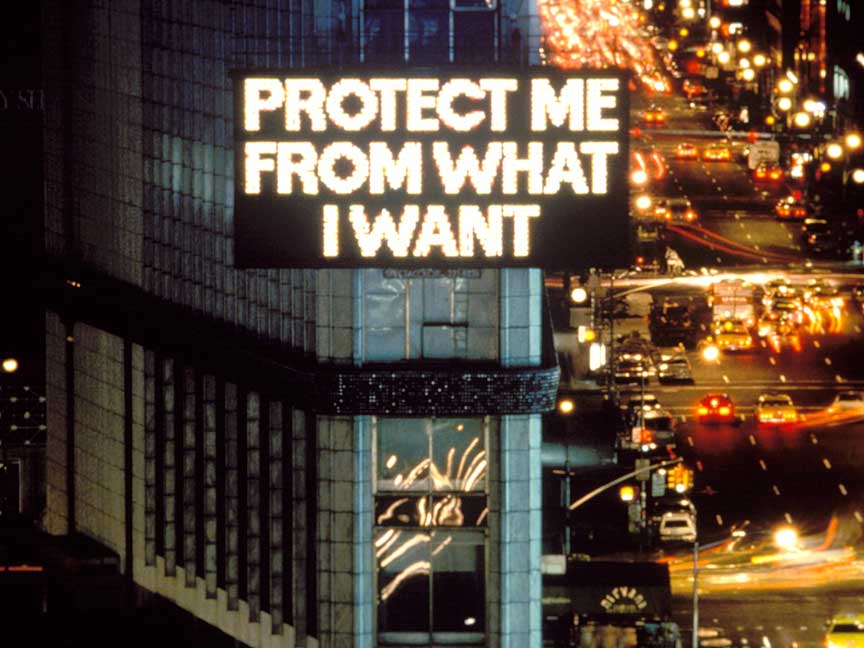
Artist Jenny Holzer put up an illuminated billboard in Times Square in 1986 as part of her well known "Survival" series. The imperative "Protect me from what I want" called attention to the intrusion of advertising, the commercial exploitation of public space, and our helplessness within the situation. Now appreciators of art can own that experience for themselves and support the Whitney Museum by purchasing a pair of Keds sneakers. Get them at Bloomingdale's starting 8 July, $75 for high tops, $70 for low tops. As Tom Scocca pointed out, buying shoes emblazoned with messages about mass market consumption prices are essentially announcing that you, the consumer, paid a mark-up of 100%.

The Holzer designed sneakers. Image from the New York Times.
Welcome to the 25th anniversary celebration of American consummerism critique. Buy your special deluxe edition of Don DeLillo's White Noise now. Maybe we would do better to retreat all the way back to the nineteenth century and the foundational sociology of Georg Simmel on the "tragedy of culture." I may get to when I finish listening to Naomi Klein on my iPod.
30 May 2010
The Fourth Plinth Again | Yinka Shonibare

On 24 May 2010 Yinka Shonibare, a British artist raised in Nigeria, added his own naval-themed sculpture to the victorious monuments in Trafalgar Square.
The Mayor of London's office has commissioned another work for that one empty plinth in Trafalgar Square. I mentioned the last work on the plinth outside the National Gallery in October, Anthony Gormley's round-the-clock parade of ordinary people. But last week the gently subversive Yinka Shonibare unveiled his addition to the Commonwealth's most famous square, an oversized knick-knack. His sculpture reproduces the Victory, the ship that Admiral Nelson commanded at the Battle of Trafalgar in 1805, except that the Nigerian-British artist has made all those majestic sails out of Dutch wax cloth, and he has built the entire miniature inside a bottle.

Yinka Shonibare's new sculpture for the so-called Fourth Plinth juxtaposed with Nelson's column in Trafalgar Square. The portholes on the base of the work conceal fans that prevent condensation from building up in the bottle.
Nelson's Ship in a Bottle celebrates Britain's greatest naval triumph, one that opened at least a century of dominance and colonial enterprise, but Shonibare sealed the iconic ship within a polymer-glass bottle of extraordinary size, an adult could crawl through the mouth if the cork were removed. The bottle's shape evokes a vessel for rum, a product of the slave and sugar industries in the West Indies and part of sailors' daily rations. The ship-in-a-bottle composition overall evokes those quintessential Victorian hobbies of exactitude and possessiveness. That European mindset which demanded that insects or stamps be captured, cataloged, and shelved paralleled European ambitions for planting a flag on every continent.

Nelson's Ship in a Bottle between the dome of the National Gallery and the spire of St Martin's-in-the-Fields.
However, those adventures brought the country into contact with a much wider world whose people now form an integral part of British society, particularly in multi-ethnic London. The outrageous sails are of Dutch wax cloth, a type of fabric originally made in the Netherlands. The sails with red-and-black patterns recall the batik designs of Malaysia and Indonesia that Dutch colonial merchants tried to manufacture and sell at home in patterns similar to those red anchors on white background. Eventually, weak demand led the producers to try to hawk the surplus fabric in West Africa but as a conspicuously "European" product. As British, and Dutch and American and Chinese, people and ships came and went around the world our totems of cultural and ethnic distinction became intermingled, and the process has not slowed down.

The front of Nelson's Ship showing the artist's initials "YSMBE" on the red bottle seal.
The setting of Trafalgar Square and its environs host a number of embassies and High Commissions from countries formerly part of the empire: South Africa, Uganda, New Zealand, Zimbabwe. Yinka Shonibare himself is now officially part of all that confusion and the confused establishment. He was made an MBE in 2004. The honour, which stands for Member of the Order of the British Empire, appears along with the artist's initials on the giant red seal of the bottle. Mr. Shonibare loves to remind viewers of this accolade, and increasingly such globally minded innovators are essential for Britain's future. As the artist says, such people "are still breathing precious winds into the sails of the United Kingdom." Without them the accomplishments of the country would just be sealed up and collecting dust on the shelf.
Additional photos after the jump. Click the link at the lower left.
23 October 2009
Animation Nation
 Max Horovitz (voiced by Philip Seymour Hoffman) has anxiety problems. Image from the Mary & Max website.
Singapore's annual Animation Nation 2009 festival finished this week. The Passengers managed to see two wonderful, whimsical features: Mary & Max and The Secret of Kells. The week of moving pictures was put on my the Singapore Film Society and hosted at the National Museum's (blogged here) lecture theater/cinema. The selections this year included cartoons from around the world and with varying tones of seriousness. Waltz with Bashir, animated recollections from Israeli soldiers, is definitely not a kids' movie, but the adventures of Brendan through the Irish wilderness in The Secret of Kells are a young boy's fantasy.
 Aisling and Brendan explore the forest in The Secret of Kells. Guriguriblog has a great look at the film's Insular qualities.
Both of the films we saw arrived on a diplomatic platform. Mary & Max, a really touching story about unlikely pen pals writing from Australia and New York City in the 1970's, came to Singapore as part of the cultural outreach of the Australian High Commission, and the Irish HC actually sent a representative to introduce the Secret of Kells as we saw the film on the festival's opening night. The diplomatic missions to Singapore often play a visible role in the island's social/cultural scene. In part, this serves to bring a bit of home to the various ex-pat communities here, but these countries also want to promote themselves to encourage business and trade relationships with Singaporeans. Next weekend begins Berlin Dayz, courtesy of the German Embassy Singapore.
 The cat Pangur Ban in The Secret of Kells gets his name from a Gaelic poem written by an Irish monk in the ninth century. More character sketches from the filmmakers here.
 The cat Pangur Ban in The Secret of Kells gets his name from a Gaelic poem written by an Irish monk in the ninth century. More character sketches from the filmmakers here.
And did I mention The Secret of Kells weaves its tale around the creation of the famous Irish illuminated manuscript, the Book of Kells, made around 800 CE? What could be better?
13 October 2009
Down on the Corner, Out in the Street
 José Rafael Moneo standing within the Columbia campus in front of his first New York project. Photo from the New York Times.
Early reviews are trickling in about a new landmark taking shape in upper Manhattan, Columbia University's new interdisciplinary science building. The tower balances on pillars above a very active gym and fitness center at the corner of Broadway and 120th Street. The design by José Rafael Moneo places a largely glass facade toward the campus interior, but the architect reduced the transparency of the street-facing glass by cladding the tower with a grid of panels striated with diagonal slits on either side of the outer trusses. The textural effect recalls the landscaped hedges that top the group entrance hall of Rafael Moneo's expansion at the Museo Prado. The lowest story remains incomplete and unformed, but it is supposed to hold an inviting public cafe. For a multimedia tour of the construction site visit the campus newspaper's website.
 An architect's rendering of the building from 2007 showing the corner of Broadway & 120th Street.
The corner marks the convergence between Columbia, Teachers' College, Barnard, and Union Theological Seminary, and the architectural expression of self-importance for each institution means that no doors presently face onto this space. The presence of a public entrance or convenience on this spot would be a welcome, humanizing addition to the neighborhood. The more troubling relationship for the new structure is one of form and scale.
Columbia's main campus, stretching from 114th Street to 120th Street, largely conforms to McKim, Mead & White's fin de siécle plan for an enclosure of classical learning within classical, brick-faced architecture. The university has largely upheld these two tenets, with the exception of a Renzo Piano-designed student union and a handful of non-Western courses appended to the undergraduate core curriculum. However, the science building has no red brick materials or references to classical architecture. This is the disjunction that prompts former Columbia professor Barry Bergdoll to declare the building "provocative." Bergdoll is also right to acknowledging that the project creates a new focus on the north end of campus. Perhaps the visual role of this building will become clear with the construction of Columbia's new, and somewhat controversial, science-heavy campus in Harlem.
 West 130th Street as envisioned by Columbia University's Manhattanville in West Harlem redevelopment project.
09 October 2009
Broadsheet typos - The Fourth Plinth
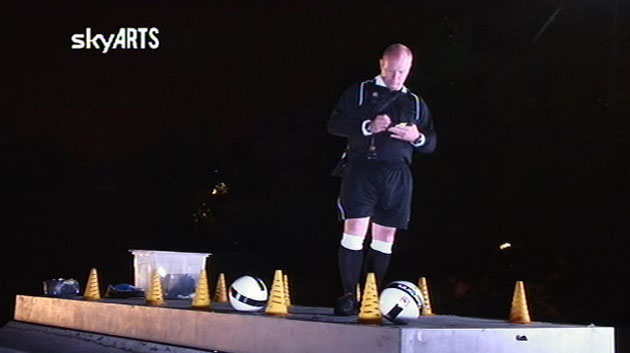 Sam Martin appointed himself referee of Trafalgar Square one night, starting at 3am.
Even the venerable journalistic newspapers of Britain are showing signs of decline in the internet age. Fewer copy editors means more typographical errors in print and online. This one came from a Guardian review of, or maybe a comment on, Anthony Gormley's art installation that put ordinary Britons atop the usually empty fourth plinth in Trafalgar Square.
So it [Gormley's One & Other project] was popular before it began, and that popularity has not diminished. It has been widely celebrated as a democratic portrait of Britain in the 12st century.I love this error because the ambiguity provokes such enjoyable speculation. What did the author Jonathan Jones really intend to write? Was One & Other "a democratic portrait of Britain in the 12th century," an insightful, modern take on the formative decades following the Norman Conquest? Perhaps the text is correct and this refers to some system of describing an era by weight. A 12-stone (168 lbs./76.2 kg) century would be a sturdy lady but a well-proportioned chap (to the Americans: people are weighed in stone in Britain and Ireland at 14 pounds/stone). The other intention might be "in the 21st century," but this hardly seems humorous.
Gormley's installation was a provocative piece of theater and certainly a populist stroke of creativity. The article includes a worthwhile slideshow of what people choose to do when given an hour of public prominence. The newspaper also featured a review that contradicted Jones' critique.
29 September 2009
York St Mary's - Five Sisters Installation
 York St Mary's serves as an exhibition space for which the York Museums Trust regularly commissions site-specific artworks. The medieval parish church was deconsecrated in 1958.
Today was my last full day in York, a chance to catch up on a few last details of fieldwork before sending myself back towards London tomorrow morning. I made sure to drop by York St Mary's during a lunch break to photograph their current installation: Five Sisters.
The exhibition caught my eye because it uses the same nickname given to the towering transept facade inside the city's cathedral, York Minster. The artists Emma Biggs and Matthew Collings drew on the aesthetics of these five lancets to create their composition in mosaic and canvas painting. At the Minster, these soaring fields of glass were not decorated with representations of stories or saints, instead a mostly monochromatic scheme of grisaille glass was used to create geometric arrangements.
 The glass in the so-called "Five Sisters" windows at York Minster was probably installed around 1250.
 A detail of the "Five Sisters" glass patterns (via Traditional Building). Thirteenth-century stained glass compositions generally limited the use of saturated fields of red and blue compared to earlier Gothic tastes. Lighter colors and clearer glass admitted more light.
The mosaic along the nave of the church uses local fragments of pottery from the thirteenth and fourteenth century for tesserae. The homage to the Middle Ages becomes explicit, and the reuse of these shards calls attention to how succeeding generations treat objects of the past. These potsherds come from the York Museums Trust, and I assume that their collection has a surfeit of such remnants. Most preservation institutions are awash with historical bric-a-brac, only a small fraction of which could be put on display, only a fraction of which would interest the visiting public.
 Emma Biggs & Matthew Collings, Five Sisters, 2009. Monochromatic paintings are placed at either end of the mosaic.
 Detail of the tesserae in Emma Biggs & Matthew Collings, Five Sisters, 2009.
So what is a museum to do with all these shards? Similarly, how is a city like York supposed to manage its past after 2,000 years of continuous history? This installation allows artifacts to be both used and seen, and the venue itself, a decommissioned thirteenth-century parish church, came about through parallel circumstances. York has 19 surviving medieval parish churches, a more than adequate supply for the population's present Anglican needs. For artists, creative expressions and materials and techniques always arise out of earlier ideas and labor, and these creations must always contend with the "greats" of the past. In this case, Biggs and Collings place their borrowings front and center for everyone to consider.
25 September 2009
The Staffordshire Hoard
 An especially deep plowing is suspected to have brought the buried treasure close to the surface this year.
An unemployed man with a metal detector in July unearthed the largest cache of Anglo-Saxon artifacts ever found in Britain. The lucky strike includes over 1500 objects, mostly of precious metals and gemstones, probably buried around AD 700 for safekeeping. Word of the discovery only went out today with an unveiling at the Birmingham Museum and Art Gallery. Since Terry Herbert first notified the portable antiquities scheme professional archaeologists have been working covertly in the field where the objects were found to try uncover more information about what took place there 1300 years ago. The exact location still remains secret and the Home Office is overseeing the excavations to keep out would-be looters.
 Many of the precious objects were used to decorate swords, probably the spoils of warfare around the Midlands kingdom of Mercia. (from the BMAG flickr stream)
 The overwhelming collection has been designated as "treasure" and thus belongs to the State. However, British museums will bid to take possession of the hoard. The final price will be divided between Mr. Herbert and the farmer who owns the field in which the find was made. These objects will keep curators, archaeologists, and art historians busy for years conserving and inspecting each piece for new historical insights into the so-called Dark Ages. The museum has great images of some of the treasure on flickr. The Guardian also has a slideshow, as does The Times.
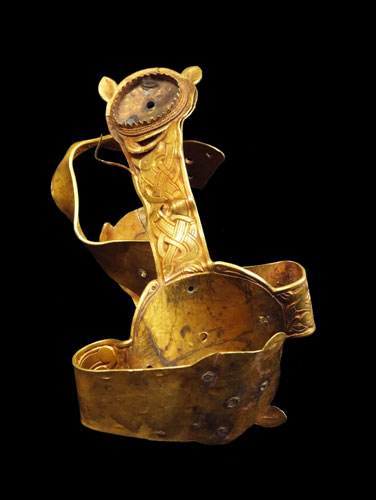 The twisted state of this cross decorated with interlace lead researchers to surmise it was plundered as gold booty. I assume the item was removed from the cover of a gospelbook.
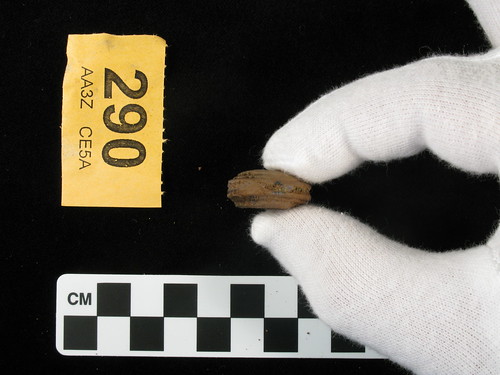 Small, precious items allowed the ruling classes of Europe to carry and secrete their wealth (from the BMAG flickr stream).
16 September 2009
Society of Antiquaries, London
 The two galleries high above the main room can make finding books an adventure.
Today has been a work day using the library at the Society of Antiquaries. Founded in 1707, the society studies the remains of Britain's, and sometimes the wider world's, past. Its quarters off of Piccadilly and inside Burlington House, also home of the Royal Academy of Arts, are frequented by (mostly) men interested in archaeology, architectural history, genealogy, numismatic, and other arcane pursuits. The scholars may look as dusty as the books, but the atmosphere is warm, and the collection is outstanding. Many of the books date to the eighteenth and nineteenth centuries. The stately setting and the vast expanses of shelves make the library a great place to read and explore. I took these pictures a couple years ago, but I assure you the place has not changed.
 The main room of the library.
 The spiral staircase in the corner leads from the first gallery up to the second.
 The Society's rooms overlook the courtyard of Burlington House. In 2006 Damien Hirst's 35-foot bronze Virgin Mother welcomed visitors to the Royal Academy's Summer Exhibition.
07 July 2009
Putting the "Real" in Real Estate
Update (9 July 2009): The Times Magazine has removed this slide show from its website because several photos in the series were "digitally altered" and "did not wholly reflect the reality they purported to show." These alterations were not disclosed by the artist, and alert viewers (hat tip: Simon Owens) produced evidence of computer manipulation, such as the composition of a timber-framed interior created by photographing half the scene and completing the tableau with a mirror image of the initial photo.
 A seven-bedroom "stockbroker Georgian" house in Greenwich, CT, now in repossession. Image by Edgar Martins for the New York Times Magazine.
Last night the Passengers explored the streets of Singapore’s Chinatown and sampled some excellent street vendors’ food. Among the topics of conversation was the incredible downturn in real estate prices across the developed world. Even Singapore has been hit as asking prices for high-end apartments in our building are rumored to be down 50% or more. Most Singaporeans remain stunned by the incredibly perverse lending undertaken by American consumers at the height of the bubble. Retail banking here seems quite staid by American and British norms. Try finding a savings account in Singapore that pays more than one percent APY.
On this topic I want to call attention to a photo essay commissioned by the New York Times Magazine last week. Portuguese photographer Edgar Martins thoughtfully captured the overreach in real estate in the United States. With emphatic verticals and deep fields of vision his images show aspirational follies in the household, holiday, and commercial markets. The depopulation and abandonment on display reveal the hubris behind each project. Leaves blow through an unsecured living room. Timber frames wait for dry wall, and a solitary box mysteriously blocks up the only opening in a concrete edifice. Martins describes his visualizations attempts “to portray the inherent movement in stillness. Sometimes objects become almost like events.” Here the viewer has been inserted in the uncertain moment after building has stopped but before new action has begun.
 Downtown condos in Phoenix, AZ, stand unfinanced and unfinished. Image by Edgar Martins for the New York Times Magazine.
These photos do ask the viewers to roll up their sleeves and avert failure. The slideshow title “Ruins of the Second Gilded Age” leaves little doubt that an unfavorable judgment has been passed against American indulgence, and the images feature almost no tools that suggest a means to finish the work. Building materials appear on a street of downtown condos, but no forklifts are available to move them. Trash litters a driveway in Georgia without a dumpster to clear it. Furthermore, the artist and/or editors have chosen to visit unsympathetic locations, including those hyped by the artist’s patron. Building for a wealth population in Greenwich, CT, also allowed for spectacular losses on speculative homes. Las Vegas seemingly drew upon an inexhaustible pool of perceived wealth until homeowners balked at the high price demanded by Sin City. Martins' series once again points up the ability of images to make tragically real the stories told by journalists and economic data.
 An unfinished model home in a Chandler, AZ, subdivision appears as an abandoned cathedral through Edgar Martins' lens.
 02 July 2009
Fitting in at NMS

The National Museum of Singapore devotes itself to telling the history of Singapore starting from the fourteenth century. It also holds festivals that contribute to the state’s ongoing cultural life and hosts traveling exhibitions. Its mission seems a strange amalgam, especially as Singapore also has a visual arts museum and two institutions for cultural history. However, the National Museum can claim some apostolic exceptionalism since it took over duties from the colonial Raffles Library & Museum and its 1887 building by Sir Henry Edward McCallum.
The building was certainly not designed as a modern museum with intuitive traffic flow and flexible galleries. A modern overhaul began in 2003 and has created some inviting passages that harness the charm of the historic building while appending much-needed exhibition space. Almost all major museums in the post-War era have struggled to adapt to their staid homes. Old buildings psychically project legitimacy and gravitas, but many old museums were built for showing their collections as jumbles of knick-knacks and curiosities, not as a series of items requiring discreet displays for studying for each artifact.
 Suzann Victor, Contours of a Rich Manoeuvre, each chandelier hangs 3m from bridge floor.
 S. Teddy Darmawan, Love Tank (The Temple), 2008-2009; roughly 3 x 5 x 8m
Another artist S. Teddy Darmawan has received temporary control over the main entryway. The Indonesian artist has stacked seven pink tanks (modeled on the M1 Abrams) underneath the museum’s iconic dome. Love Tank fills the height and breadth of the rotunda and crowds visitors immediately upon entrance. Ordinarily, a museum would consider such an installation unwelcoming and disruptive. Even MoMA, a museum that pays lip service to offering museum-goers provocative experiences, deemed it best to toy with visitors only after they pay $20. NMS, however, has a low porch over its entryway, and without the pile of tanks blocking the view arriving visitors would normally behold a steep staircase on the opposite side of a cramped rotunda. The architecture already required hiding the ticket counter to the left behind the low arcade, and the addition of S. Teddy D.’s installation helps declare this museum a place of experience and exploration rather than simple tourism. The riotous color scheme and lotus blossom patterning on the muscular masses of the tanks repeats the subversion of colonial architecture and self-serious/self-serving institutions. But if all that gets too antiestablishment, the museum does have an upscale restaurant (sound alert).
 Love Tanks and the NMS dome with its original Victorian stained glass.
29 June 2009
Reworking Westminster
 An aerial view of Westminster shows the abbey (foreground) with its present cap over the crossing of the nave and transept.
Big news for those of us who visit ancient churches: Westminster Abbey today announced plans for a gilded top over the church's crossing space. Currently, the building has a little stumpy finish in the middle of its roof because no previous architects, including Sir Christopher Wren, Nicholas Hawksmoor, and George Gilbert Scott, could come up with a structurally sound design within cost constraints. The new addition would sit atop the site of every English monarch’s coronation since William the Conqueror. The planned corona is part of a larger refurbishment of the abbey intended to add exhibition spaces along unused triforium level and amenities like a refectory.
As an art historian, I am of two, maybe more, minds about this development. My research depends upon accessing and visualizing medieval in their original state, but I fully recognize the many interests and activities that must compete for space inside an historic institution living in an historic building. Aside from ecclesiastical and tourist obligations, the church and its treasures must be maintained and secured. Add in an active music program, a world-class school, and a Poets’ Corner. It’s an absolute scrum for space and resources under a non-profit business model. These places must adapt in order to serve their mission and constituencies. Plus, the buildings I study often replaced earlier structures deemed inadequate or out-of-date. Renovation and replacement are constant in architecture as much as conversation and veneration.
 King Edward the Confessor is interred in the old Westminster Abbey. Detail of the Bayeux Tapestry, c. 1077; Musée de la Tapisserie de Bayeux, Bayeux.
For the most part, England’s great churches have adapted over centuries. Clerics have prayed at Westminster since 960, and Edward the Confessor’s grand abbey appeared in the Bayeux Tapestry. The present building began under Henry III’s patronage in 1245, and numerous building campaigns since have lengthened the nave and added the western towers. Henry VII rebuilt the Lady Chapel in an ornate Perpendicular mode that became the model for the Palace of Westminster (Houses of Parliament) next door. Plus, the Suppression of the monasteries under Henry VIII threatened all of England’s abbeys with destruction.
 The Swiss Re building by Lord Foster rises above the Tower of London.
Such history means I would be foolish to suggest that every medieval church should continue its eternal mission whilst frozen in a monument built for other times and demands. However, the new corona represents the first major alteration to the silhouette of any of England’s remaining medieval churches since a few nineteenth-century restorers heightened a few towers, like George Gilbert Scott at Bridlington, or pulled down rotting spires. This is renovation on a scale beyond installing fresh stained glass in a few lancets. It will further alter a London skyline that has evolved significantly in the last decade with the addition like the London Eye and the Swiss Re building, aka the Gherkin.
Additionally, the abbey has long enjoyed/endured a symbiotic relationship with the Crown. Architectural historians have long noted the building’s physical similarities and symbolic correspondence to Reims cathedral, the coronation church of the French kings. The Dean and Chapter who now oversee the church have asked for public comments on its proposed developments, but Prince Charles, a notorious critic of modern architecture, would be the first monarch crowned under the new structure. The new corona, Latin for “crown,” will intensify and reassert the connection between Church and State in Britain, and the Royals will continue to have some say over the appearance of Westminster Abbey.
 The space in front of the high altar has seen the crowning of every English monarch since Edward I.
Subscribe to:
Posts (Atom)




.jpg)