Showing posts with label Britain. Show all posts

29 April 2011

The Big Day in the UK


We can only hope the event will be this festive.

There's a wedding happening today at Westminster Abbey. The Passengers will watch a bit of the ceremony from Changi Airport because we are flying to Thailand for a long weekend. Here in Singapore the royal occasion will be less of a morning event and more of a prime-time affair. The service starts at 6pm for us. Rest assured, Channel 5 will start coverage three hours early.

The video above is sponsored by T-Mobile. I was amused. Then, I had to confirm to myself that the setting was St Bartholomew's in Smithfield, a Romanesque Augustinian Abbey.

18 March 2011

Peterhouse College, Cambridge

Facing the Peterhouse chapel. The formal hall is on the right.
I just finished attending a symposium at Cambridge University. I had a great time meeting fellow postgraduates in the history of art, and my paper was well received by Tuesday's audience. Of course, one of the highlights of being in Cambridge is the architectural scenery. The conference organizers put me up in a room in Peterhouse Collge, the university's oldest college.

The other side of the courtyard. The underpass in the center is known as "Noah's Ark."
The event included a formal hall dinner at Peterhouse, a day trip to nearby Ely Cathedral, and a good helping of many aspects of Cambridge life. One of my evenings included drinking sherry in the Pembroke College bar at £7.90 per bottle. It's an easy life here with stunning surroundings. More pictures of Peterhouse are after the jump; click on the link below left to see them. Soon I will be flying back to Singapore for more tropical adventures.

30 May 2010

The Fourth Plinth Again | Yinka Shonibare

On 24 May 2010 Yinka Shonibare, a British artist raised in Nigeria, added his own naval-themed sculpture to the victorious monuments in Trafalgar Square.

The Mayor of London's office has commissioned another work for that one empty plinth in Trafalgar Square.  I mentioned the last work on the plinth outside the National Gallery in October,  Anthony Gormley's round-the-clock parade of ordinary people.  But last week the gently subversive Yinka Shonibare unveiled his addition to the Commonwealth's most famous square, an oversized knick-knack. His sculpture reproduces the Victory, the ship that Admiral Nelson commanded at the Battle of Trafalgar in 1805, except that the Nigerian-British artist has made all those majestic sails out of Dutch wax cloth, and he has built the entire miniature inside a bottle.

Yinka Shonibare's new sculpture for the so-called Fourth Plinth juxtaposed with Nelson's column in Trafalgar Square.  The portholes on the base of the work conceal fans that prevent condensation from building up in the bottle.

Nelson's Ship in a Bottle celebrates Britain's greatest naval triumph, one that opened at least a century of dominance and colonial enterprise, but Shonibare sealed the iconic ship within a polymer-glass bottle of extraordinary size, an adult could crawl through the mouth if the cork were removed.  The bottle's shape evokes a vessel for rum, a product of the slave and sugar industries in the West Indies and part of sailors' daily rations.  The ship-in-a-bottle composition overall evokes those quintessential Victorian hobbies of exactitude and possessiveness.  That European mindset which demanded that insects or stamps be captured, cataloged, and shelved paralleled European ambitions for planting a flag on every continent.

Nelson's Ship in a Bottle between the dome of the National Gallery and the spire of St Martin's-in-the-Fields.

However, those adventures brought the country into contact with a much wider world whose people now form an integral part of British society, particularly in multi-ethnic London.  The outrageous sails are of Dutch wax cloth, a type of fabric originally made in the Netherlands.  The sails with red-and-black patterns recall the batik designs of Malaysia and Indonesia that Dutch colonial merchants tried to manufacture and sell at home in patterns similar to those red anchors on white background.  Eventually, weak demand led the producers to try to hawk the surplus fabric in West Africa but as a conspicuously "European" product.  As British, and Dutch and American and Chinese, people and ships came and went around the world our totems of cultural and ethnic distinction became intermingled, and the process has not slowed down.

The front of Nelson's Ship showing the artist's initials "YSMBE" on the red bottle seal.

The setting of Trafalgar Square and its environs host a number of embassies and High Commissions from countries formerly part of the empire: South Africa, Uganda, New Zealand, Zimbabwe.  Yinka Shonibare himself is now officially part of all that confusion and the confused establishment.  He was made an MBE in 2004. The honour, which stands for Member of the Order of the British Empire, appears along with the artist's initials on the giant red seal of the bottle.  Mr. Shonibare loves to remind viewers of this accolade, and increasingly such globally minded innovators are essential for Britain's future.  As the artist says, such people "are still breathing precious winds into the sails of the United Kingdom."  Without them the accomplishments of the country would just be sealed up and collecting dust on the shelf.  
Additional photos after the jump.  Click the link at the lower left.

23 November 2009

John Sentamu

In 2006 the Archbishop spent a week living inside a tent in York Minster.

The Guardian has published an interview today with the Archbishop of York John Sentamu. The article includes a funny anecdote in which the interviewer Stephen Moss assumed the Archbishop lived within the precinct of York Minster. Actually, the Primate of England has his official palace at Bishopthorpe and has lived there since 1241.

The Church of England's No. 2 came to Britain as a political refugee from Uganda in the 1970's. The presence of an African like Sentamu at York emphasizes the global scale of the Anglican Communion and the challenges it faces in holding together such a diverse flock. Hopefully, I will have the chance to meet him on one of my travels up North. Also the Archbishop gets to sit in the House of Lords.

26 October 2009

Summer's End

British Summer Time (BST) came to an end yesterday. Britain returns to Greenwich Mean Time (GMT), making it now eight hours behind us in Singapore. Singapore doesn't bother with daylight savings time gimmicks because the island lies about 50 km north of the equator. At this latitude the days are always about twelve hours long. In the USA, Daylight Time was expanded by Congress in 2005 to begin earlier with and run later starting with calendar year 2007. American clocks will fall back on 1 November 2009.

09 October 2009

Broadsheet typos - The Fourth Plinth

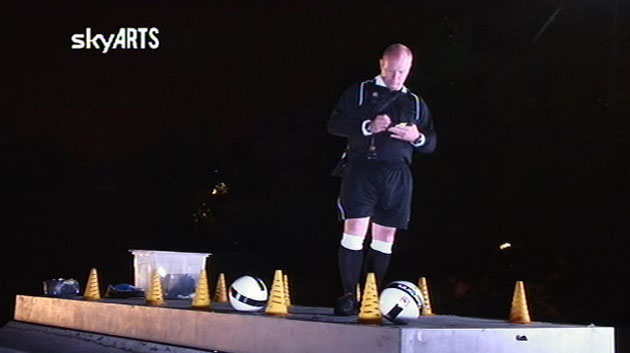
Sam Martin appointed himself referee of Trafalgar Square one night, starting at 3am.

Even the venerable journalistic newspapers of Britain are showing signs of decline in the internet age. Fewer copy editors means more typographical errors in print and online. This one came from a Guardian review of, or maybe a comment on, Anthony Gormley's art installation that put ordinary Britons atop the usually empty fourth plinth in Trafalgar Square.
So it [Gormley's One & Other project] was popular before it began, and that popularity has not diminished. It has been widely celebrated as a democratic portrait of Britain in the 12st century.
I love this error because the ambiguity provokes such enjoyable speculation. What did the author Jonathan Jones really intend to write? Was One & Other "a democratic portrait of Britain in the 12th century," an insightful, modern take on the formative decades following the Norman Conquest? Perhaps the text is correct and this refers to some system of describing an era by weight. A 12-stone (168 lbs./76.2 kg) century would be a sturdy lady but a well-proportioned chap (to the Americans: people are weighed in stone in Britain and Ireland at 14 pounds/stone). The other intention might be "in the 21st century," but this hardly seems humorous.

Gormley's installation was a provocative piece of theater and certainly a populist stroke of creativity. The article includes a worthwhile slideshow of what people choose to do when given an hour of public prominence. The newspaper also featured a review that contradicted Jones' critique.

29 September 2009

York St Mary's - Five Sisters Installation

York St Mary's serves as an exhibition space for which the York Museums Trust regularly commissions site-specific artworks. The medieval parish church was deconsecrated in 1958.

Today was my last full day in York, a chance to catch up on a few last details of fieldwork before sending myself back towards London tomorrow morning. I made sure to drop by York St Mary's during a lunch break to photograph their current installation: Five Sisters.

The exhibition caught my eye because it uses the same nickname given to the towering transept facade inside the city's cathedral, York Minster. The artists Emma Biggs and Matthew Collings drew on the aesthetics of these five lancets to create their composition in mosaic and canvas painting. At the Minster, these soaring fields of glass were not decorated with representations of stories or saints, instead a mostly monochromatic scheme of grisaille glass was used to create geometric arrangements.

The glass in the so-called "Five Sisters" windows at York Minster was probably installed around 1250.

A detail of the "Five Sisters" glass patterns (via Traditional Building). Thirteenth-century stained glass compositions generally limited the use of saturated fields of red and blue compared to earlier Gothic tastes. Lighter colors and clearer glass admitted more light.

The mosaic along the nave of the church uses local fragments of pottery from the thirteenth and fourteenth century for tesserae. The homage to the Middle Ages becomes explicit, and the reuse of these shards calls attention to how succeeding generations treat objects of the past. These potsherds come from the York Museums Trust, and I assume that their collection has a surfeit of such remnants. Most preservation institutions are awash with historical bric-a-brac, only a small fraction of which could be put on display, only a fraction of which would interest the visiting public.

Emma Biggs & Matthew Collings, Five Sisters, 2009. Monochromatic paintings are placed at either end of the mosaic.

Detail of the tesserae in Emma Biggs & Matthew Collings, Five Sisters, 2009.

So what is a museum to do with all these shards? Similarly, how is a city like York supposed to manage its past after 2,000 years of continuous history? This installation allows artifacts to be both used and seen, and the venue itself, a decommissioned thirteenth-century parish church, came about through parallel circumstances. York has 19 surviving medieval parish churches, a more than adequate supply for the population's present Anglican needs. For artists, creative expressions and materials and techniques always arise out of earlier ideas and labor, and these creations must always contend with the "greats" of the past. In this case, Biggs and Collings place their borrowings front and center for everyone to consider.

26 September 2009

National Railway Museum, York

The Great Hall of the National Railway Museum holds train engines from Britain, Japan, and China. Some of the rolling stock hails from the nineteenth century.

During previous visits to York, I have always been too busy with research to stop in to the National Railway Museum, despite all the good press it receives. Fortunately, one of my stays here finally included a Sunday, which forces me to take a break from church visits (I was raised much too properly to wander the aisles staring upwards and scrutinizing the profiles of vault ribs as a vicar delivers his homily). I decided instead to apply my medieval mind to something much more modern.

Despite the obvious hypocrisy, this art historian find train enthusiasts to be very boring creatures overly concerned about defunct institutions and outdated technology. However, the museum takes care to tell how the history of train travel in Britain, and worldwide, changed leisure, trade, politics, and industry. Railroads opened up all sorts of opportunities and their historical course includes sites for everyone's interests. That and the place is full of huge locomotives that are big, heavy, expensive, powerful, and go faster and faster and faster. I admit I handed control of my afternoon over to childish enthusiasms, but I condoned my glee by reminding myself that I was tech-gawking at rolling stock, not high-powered war machines. Below are some photos. It's a little heavy on boy material (locomotives), but I assure everyone that I did take the time to see the beautifully appointed Royal carriages dating back to Queen Victoria.

The National Railway museum sits behind York's passenger terminal in what used to be the York Freight Depot Goods Warehouse for the Northeastern Railway Company.

The Duchess of Holland was built in 1938 and streamlined with ultra-sleek cladding, but all of its style was removed during World War II. Its shape and colors were only restored this year.

The NRM collection continues to expand. Here in "The Workshop" conservators labor to return the famous Flying Scotsman steam engine to working order.

The Mallard set the current world speed record for a steam-powered train in 1938: 126 mph.

The electric turntable at the center of the Great Hall helped trains at York station turn around from 1954 until the end of steam service in 1968. The museum holds daily demonstrations.

25 September 2009

The Staffordshire Hoard

An especially deep plowing is suspected to have brought the buried treasure close to the surface this year.

An unemployed man with a metal detector in July unearthed the largest cache of Anglo-Saxon artifacts ever found in Britain. The lucky strike includes over 1500 objects, mostly of precious metals and gemstones, probably buried around AD 700 for safekeeping. Word of the discovery only went out today with an unveiling at the Birmingham Museum and Art Gallery. Since Terry Herbert first notified the portable antiquities scheme professional archaeologists have been working covertly in the field where the objects were found to try uncover more information about what took place there 1300 years ago. The exact location still remains secret and the Home Office is overseeing the excavations to keep out would-be looters.

Many of the precious objects were used to decorate swords, probably the spoils of warfare around the Midlands kingdom of Mercia. (from the BMAG flickr stream)

The overwhelming collection has been designated as "treasure" and thus belongs to the State. However, British museums will bid to take possession of the hoard. The final price will be divided between Mr. Herbert and the farmer who owns the field in which the find was made. These objects will keep curators, archaeologists, and art historians busy for years conserving and inspecting each piece for new historical insights into the so-called Dark Ages. The museum has great images of some of the treasure on flickr. The Guardian also has a slideshow, as does The Times.

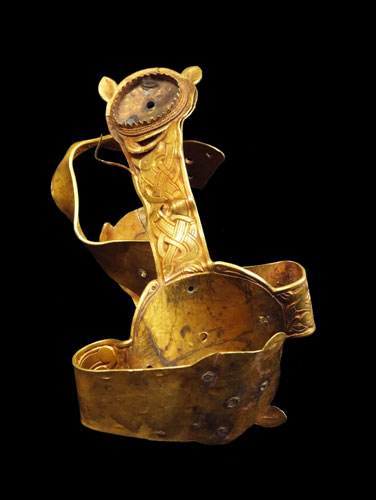
The twisted state of this cross decorated with interlace lead researchers to surmise it was plundered as gold booty. I assume the item was removed from the cover of a gospelbook.

Small, precious items allowed the ruling classes of Europe to carry and secrete their wealth (from the BMAG flickr stream).

18 September 2009

Euston Arch Trust

The Euston Arch, designed by Philip Hardwick and enginneered by Charles Fox, welcomed visitors to the station for nearly 125 years.

Wednesday featured a visit to an event promoting the Euston Arch Trust. The organization is gathering support to rebuild the monumental entrance that marked the London terminus of the London and Birmingham Railway since 1837. The Greek Revival propylaeum stood to the north of Euston Road until 1961, when it was unfortunately demolished. An iconic London building was lost, but the outrage that ensued galvanized modern efforts to preserve Britain's architectural treasures. The grand Victorian edifice of St Pancras Station next door was one of the principal beneficiaries. The course of New York's preservation movement led down a very similar valley with the loss of the Penn Station providing the impetus needed to retain Grand Central Terminal.

A column fragment from the Euston Arch was removed from the Prescott Channel in 1994 for the BBC television show One Foot in the Past.

Interestingly, the remains of the destroyed arch were finally rediscovered in 1994 at the bottom of the Prescott Channel, an industrial canal in East London. Historian Bob Cruickshank managed to unwind the story of how Bob Cotton, an engineer at British Waterways, procured the stone from the demolition site to patch a hole at the bottom of the canal. About thirty pieces of stone have now been retrieved.

Efforts to rebuild the arch have waxed and waned for years, but interest has gathered since National Rail announced a major redevelopment of Euston Station in 2007. The trust is now campaigning to make the arch the landmark feature of the new facility.

Joe Robson created this rendering of the proposed arch on its new location along Euston Road.

15 September 2009

Pub Lunch in Farringdon

The Passengers took H's parents for an enjoyable outing in London last week. We wandered the streets around Farringdon Station and Smithfield Market. I'll provide more photos later of the area's architectural delights. The highlight of the day was lunch at the Fox & Anchor, an impeccably equipped gastropub off Charterhouse Square run by the boutique hoteliers responsible for the nearby Malmaison Hotel. The snug dining nooks inside the pub have been clad in dark wood and warm lights glint off the pewter beer tankards. Add oysters, homemade pork pies, and a syllabub dessert and you have a classic of British hospitality and cuisine. Also I love the historic art deco building.

The Fox & Anchor is also an inn with six rooms available.

Drinkers have long benches and all the day's papers at the bar.

Diners sit in the back rooms and contemplate the pie of the day.

24 August 2009

Student Discounts

National Rail enlisted glam rocker (and later sex offender) Gary Glitter to promote their Young Persons Railcard. Turns out hindsight has a sense of humor (thank you, bitterwallet).

My upbringing by a coupon-clipping mother has taught me to feel proud of searching out good bargains. I admit I enjoy the thrill of possibility whilst elbows deep in the disorganized bins at down-market clearance stores. At other times I am simply the guy with tips on where to reliably find a good men's shoe sale. My favorite cost-cutting mechanism: the student discount. It's like a coupon that can't expire until graduation.

Last weekend I exercised Club Monaco's newly offered discount on purchases for myself and Passenger H. It's a great offer since I think the shop asks about 20% too much their merchandise anyhow. J. Crew also lends a hand to students, but they fluctuate their rates and terms regularly. My university also let's me buy cheap movie vouchers and Broadway tickets through their box office. Plus, loads of New York museums that give free or reduced admissions.

Of course, European countries are even more generous to students, especially when it comes to the expenses of daily life. Britain gives students 1/3 off rail fares. Amtrak only does 15%. Apparel retailers in Britain who cut students a ten-percent break include Topshop and Uniqlo. But what really underscores the difference for my European colleagues is the astounding situation whereby stipends given to students in America that exceed tuition and fees are taxed as income. Heaven knows what the IRS thinks we do for food. Until then, we will take solace in all the corporate welfare we can find.

29 June 2009

Reworking Westminster

An aerial view of Westminster shows the abbey (foreground) with its present cap over the crossing of the nave and transept.

Big news for those of us who visit ancient churches: Westminster Abbey today announced plans for a gilded top over the church's crossing space. Currently, the building has a little stumpy finish in the middle of its roof because no previous architects, including Sir Christopher Wren, Nicholas Hawksmoor, and George Gilbert Scott, could come up with a structurally sound design within cost constraints. The new addition would sit atop the site of every English monarch’s coronation since William the Conqueror. The planned corona is part of a larger refurbishment of the abbey intended to add exhibition spaces along unused triforium level and amenities like a refectory.

As an art historian, I am of two, maybe more, minds about this development. My research depends upon accessing and visualizing medieval in their original state, but I fully recognize the many interests and activities that must compete for space inside an historic institution living in an historic building. Aside from ecclesiastical and tourist obligations, the church and its treasures must be maintained and secured. Add in an active music program, a world-class school, and a Poets’ Corner. It’s an absolute scrum for space and resources under a non-profit business model. These places must adapt in order to serve their mission and constituencies. Plus, the buildings I study often replaced earlier structures deemed inadequate or out-of-date. Renovation and replacement are constant in architecture as much as conversation and veneration.

King Edward the Confessor is interred in the old Westminster Abbey. Detail of the Bayeux Tapestry, c. 1077; Musée de la Tapisserie de Bayeux, Bayeux.

For the most part, England’s great churches have adapted over centuries. Clerics have prayed at Westminster since 960, and Edward the Confessor’s grand abbey appeared in the Bayeux Tapestry. The present building began under Henry III’s patronage in 1245, and numerous building campaigns since have lengthened the nave and added the western towers. Henry VII rebuilt the Lady Chapel in an ornate Perpendicular mode that became the model for the Palace of Westminster (Houses of Parliament) next door. Plus, the Suppression of the monasteries under Henry VIII threatened all of England’s abbeys with destruction.

The Swiss Re building by Lord Foster rises above the Tower of London.

Such history means I would be foolish to suggest that every medieval church should continue its eternal mission whilst frozen in a monument built for other times and demands. However, the new corona represents the first major alteration to the silhouette of any of England’s remaining medieval churches since a few nineteenth-century restorers heightened a few towers, like George Gilbert Scott at Bridlington, or pulled down rotting spires. This is renovation on a scale beyond installing fresh stained glass in a few lancets. It will further alter a London skyline that has evolved significantly in the last decade with the addition like the London Eye and the Swiss Re building, aka the Gherkin.

Additionally, the abbey has long enjoyed/endured a symbiotic relationship with the Crown. Architectural historians have long noted the building’s physical similarities and symbolic correspondence to Reims cathedral, the coronation church of the French kings. The Dean and Chapter who now oversee the church have asked for public comments on its proposed developments, but Prince Charles, a notorious critic of modern architecture, would be the first monarch crowned under the new structure. The new corona, Latin for “crown,” will intensify and reassert the connection between Church and State in Britain, and the Royals will continue to have some say over the appearance of Westminster Abbey.

The space in front of the high altar has seen the crowning of every English monarch since Edward I.