Showing posts with label economy. Show all posts

05 August 2012

"National Night" in Singapore, says Mentos

It's a viral marketing video fabricated to entice bloggers and news services, but it is funny. Family warning: This video does explain how babies are made. 

In fact, making babies is the entire joke because Singapore, which turns 46 years-old on 9 August 2012, has very publicly been wringing its hands about low birthrates for a while now. Last year after learning that the total fertility rate for 2010 stood at only 1.16 – nowhere near the replacement level of 2.1 – Lee Kuan Yew (Prime Minister of Singapore for its first 25 years) famously warned that an aging Singapore would face Japanese-style stagnation after the burgeoning economic expansion that marked the country's history since independence. Mentos has given the nation's adults a new civic duty.

Update (8 Aug 2012): James Fallows one of our favorite American writers about China and East Asia has picked up on the ad sensation for the Atlantic. Hat tip: The Dish.

25 June 2010

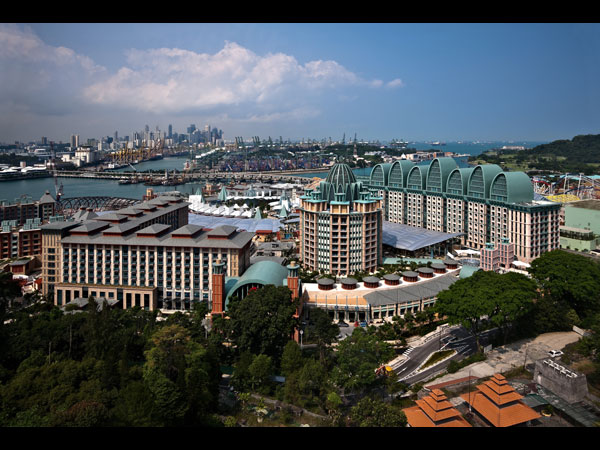
Integrated Resort 1 | Resorts World Sentosa

Resorts World Sentosa (called RWS around here because Singaporeans love acronyms) with the larger island of Sinapore in the background. All images of RWS from Slate's slideshow.

While the Passengers nervously watched USA and England keep alive their respective, overly optimistic quests for World Cup glory, Singapore welcomed the opening of its second den of iniquity integrated resort: Marina Bay Sands.  Some work remains to be done on the structure, especially the much anticipated Skypark atop the 55-story towers.  But this post piggybacks on an architectural write-up of the city-state's first integrated resort in Slate: Resorts World Sentosa. The project opened in time for the Chinese New Year in February and includes 1,740 hotel rooms spread over six locations, a maritime museum, convention and conference facilities, and loads of retail space, but these mostly serve as a fig leaf for the cash cow super casino.

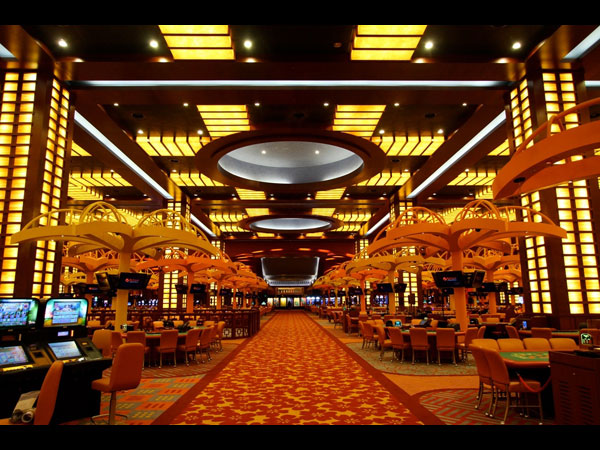
The gaming floor at RWS.

Traditionally the ruling classes party of Singapore have has looked down on gaming, but Macau is making money hand over fist from newly wealthy Chinese not allowed to gamble at home.  So Singapore decided to patronize all the punters who might patronize a casino  Only two casinos have been built and only as a part of larger euphemistically named integrated resorts.  The first project was located on Sentosa a small island to the south, even easier to control and far from most Singaporeans . Sentosa visitors pay S$3 to set foot on the island, and Singapore citizens must pay a S$100 (about 72 USD) admission to lose money inside the casino.  The gaming floor itself has been buried underground precisely to keep it away from public view.  Families should concentrate their excitement on the brand-name excitement above ground, a shiny new Universal Studios attraction.  Those Singaporeans unable to control their losses can be added to a blacklist and refused entry to the casino.

Slate's architectural critic Witold Rybczynski has a fair amount of praise for the 121-acre project designed by postmodern pioneers Michael Graves and Associates.  The principal and his firm have carried out something of a gesamtkunstwerk, an impressive total design effort extending from the hotel towers down to the flatware and the lamps in each hotel room.  This seems well within the capabilities of a firm that makes paper-towel holders for the discount retailer Target, but it hasn't been popular practice since the early twentieth century.

Micheal Graves Design Automatic Drip Coffeeemaker, available from Target.

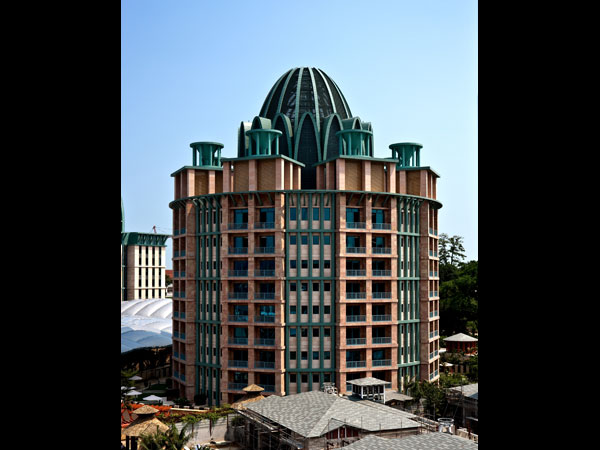
The high-end Cockfords hotel at RWS.

"Asians don't want to borrow from Western culture.  They want their own architecture.  Although they don't necessarily know what that is," says the condescending American Michael Graves.  Rybczynsky claims the Cockfords hotel was designed without the flourishes of Classicism that punctuate much of the architect's work.  This seems accurate if one ignores the green cupolas and refuses to see green rim encircling the top of the inhabitable floor as an overhanging cornice.  The design does bother to subtract any capitals from the extended pilasters that emerge to support the ring of oversized pedestals.  Also the name Cockfords does not necessarily suggest a Southeast Asian location.

Much of my hesitation to agree with Rybczynski stems from my dislike of the whimsical stunts that characterize Graves.  His play with classical devices and bold colors seems increasingly naff and bears some responsibility for some of the worst excesses of corporate architecture in the last thirty years.  However, I concede that the design probably does match the brief set forth by the patrons. This was not the first resort executed by Graves; he did Walt Disney World Swan, and his selection was probably a safe choice for Singapore.  Indeed the firm specializes in architectural fantasies so  it does not surprise that they built the blinders required to keep a supercasino super-clean.

01 June 2010

More Hopeful than Speculative

Front of ridiculous invitation.

When did we realize that Singapore is experiencing a swelling, feverish property bubble? Was it one of our friends was offered a mortgage equal to about 16 times her annual salary? Was it when property prices surpassed the record levels of 2008? Was it when the government announced another massive release of state-owned land to developers for the purpose of building more subsidized apartments to ease the speculative clamor in the private market?

Back of ridiculous invitation. Act now.

Nah. We knew that property dealers and buyers had become overenthusiastic when every flat in our building received this invitation, pictured above, to attend a sales pitch about buying condos in the capital of Mongolia.  Condos not houses or greenfield sites; Mongolia not China or Hong Kong.  Click on the images to enlarge the postcard.  Maybe global realtors CB Richard Ellis believe Ulaanbaatar has serious potential, or maybe they believe Singapore houses a profitable number of suckers.

07 July 2009

Putting the "Real" in Real Estate

Update (9 July 2009): The Times Magazine has removed this slide show from its website because several photos in the series were "digitally altered" and "did not wholly reflect the reality they purported to show." These alterations were not disclosed by the artist, and alert viewers (hat tip: Simon Owens) produced evidence of computer manipulation, such as the composition of a timber-framed interior created by photographing half the scene and completing the tableau with a mirror image of the initial photo.

A seven-bedroom "stockbroker Georgian" house in Greenwich, CT, now in repossession. Image by Edgar Martins for the New York Times Magazine.

Last night the Passengers explored the streets of Singapore’s Chinatown and sampled some excellent street vendors’ food. Among the topics of conversation was the incredible downturn in real estate prices across the developed world. Even Singapore has been hit as asking prices for high-end apartments in our building are rumored to be down 50% or more. Most Singaporeans remain stunned by the incredibly perverse lending undertaken by American consumers at the height of the bubble. Retail banking here seems quite staid by American and British norms. Try finding a savings account in Singapore that pays more than one percent APY.

On this topic I want to call attention to a photo essay commissioned by the New York Times Magazine last week. Portuguese photographer Edgar Martins thoughtfully captured the overreach in real estate in the United States. With emphatic verticals and deep fields of vision his images show aspirational follies in the household, holiday, and commercial markets. The depopulation and abandonment on display reveal the hubris behind each project. Leaves blow through an unsecured living room. Timber frames wait for dry wall, and a solitary box mysteriously blocks up the only opening in a concrete edifice. Martins describes his visualizations attempts “to portray the inherent movement in stillness. Sometimes objects become almost like events.” Here the viewer has been inserted in the uncertain moment after building has stopped but before new action has begun.

Downtown condos in Phoenix, AZ, stand unfinanced and unfinished. Image by Edgar Martins for the New York Times Magazine.

These photos do ask the viewers to roll up their sleeves and avert failure. The slideshow title “Ruins of the Second Gilded Age” leaves little doubt that an unfavorable judgment has been passed against American indulgence, and the images feature almost no tools that suggest a means to finish the work. Building materials appear on a street of downtown condos, but no forklifts are available to move them. Trash litters a driveway in Georgia without a dumpster to clear it. Furthermore, the artist and/or editors have chosen to visit unsympathetic locations, including those hyped by the artist’s patron. Building for a wealth population in Greenwich, CT, also allowed for spectacular losses on speculative homes. Las Vegas seemingly drew upon an inexhaustible pool of perceived wealth until homeowners balked at the high price demanded by Sin City. Martins' series once again points up the ability of images to make tragically real the stories told by journalists and economic data.

An unfinished model home in a Chandler, AZ, subdivision appears as an abandoned cathedral through Edgar Martins' lens.

04 June 2009

A Sign of the Times

At least one ship has cargo to deliver today. An overview of the world's busiest container port.

Borrowing a journalistic device from the Brian Lehrer Show, I present today’s “Uncommon Economic Indicator,” signs of the global downturn in pictures and events, rather than cold numbers. Most of the activity I have seen in Singapore seems oblivious to the larger economic climate, and the economy has stayed healthy in a few ways. Several important banks operating here stayed well away from the complex financial instruments that have threatened to topple American and European giants. The proliferation of cranes across the skyline demonstrates a confidence in continued demand for commercial and residential real estate. The construction shown above, outside my building's sky terrace, certainly has been running at a blistering pace.

However, from these same windows and in the background of the same image (detail, above) can be seen this revealing marker of the worldwide drop in trade. The waters around Singapore have filled up with a massive flotilla of unladen cargo ships. Notice the lack of shipping containers piled on their decks. Demand for goods in almost every market has plummeted so these ships have nowhere to go. Instead they wait in deep-water anchorage. The view above looks off to the southeast, and the pile-up beyond the port and past Sentosa appears below. This online map shows the larger parking-lot conditions in real time. The effects of stagnation remain unknown, but the prognoses suggest that Singapore cannot defy gravity endlessly.

Another view (below) looking southeast, but from a higher floor.