As readers might know, one of the Passengers' favorite discoveries in Southeast Asia has been the walkable, optimistic, fast-changing Ho Chi Minh City. The automotive traffic in the former Saigon – dominated by small motorbikes – is emblematic of the vibrant urban life of modern Vietnam. The above video, as featured on The Dish, captures some of that energy.
Showing posts with label travel. Show all posts
Showing posts with label travel. Show all posts
10 December 2011


09 December 2011
Daylesford Town
 |
| Along Raglan Street in Daylesford, Victoria. We saw wrought iron balconies like these all over town and in Melbourne. |
 |
| Perfect Drop is a good wine bar attached to a bohemian, living-room restaurant serving lots of locally produced food. |
 |
| Raglan Street in Daylesford again. Further up the road from the first picture. |
 |
| Good beer from northern Victoria, Australia |
Our destination that afternoon was a place called Daylesford, which looked, when we arrived, more like a movie set than like an actual working town. The buildings on the main street were two stories tall, and made of wood, like buildings in the Old West, but brightly painted. Here was the shop selling handmade soaps shaped like petit fours. Here was the fudgery, the jammery, your source for moisturizer. If Dodge City had been founded and maintained by homosexuals, this is what it might have looked like. “The spas are fantastic,” Pat said, and she parked the car in front of a puppet shop…
08 December 2011
Kookaburras
 |
| Lake Daylesford in Daylesford, Victoria, Australia |
Among the highlights of our trip was staying at a bed and breakfast in the spa town of Daylesford. Every morning, and on some evenings, we walked around the very scenic lake, seen above. At the beginning of one stroll we heard the cackling of kookaburras in the bush, and we were delighted when a pair of them alighted on a low branch just beside our path. Click on the pictures for larger images.
 |
| Kookaburras are carnivorous. They even eat poisonous snakes. |
 |
| On our first morning in Daylesford we definitely heard kookaburras in the bush. This was the second pair we sighted on our trip. |

UPDATE (19 December 2011): I found the essay David Sedaris wrote about feeding a kookaburra in Daylesford for the New Yorker in 2009.
... I was already overstimulated, but how often in life do you get such an offer [to feed a kookaburra]? That’s how I found myself on the deck, holding a bowl of raw duck meat cut into slender strips. At the sight of it, the bird stood up and flew onto my arm, which buckled slightly beneath the weight.
“Don’t be afraid,” the waiter said, and he talked to the kookaburra in a soothing, respectful voice, the way you might to a child with a switchblade in his hand. For that’s what this thing’s beak was—a serious weapon. I held a strip of raw duck, and after yanking it from my fingers the bird flew back to the railing. Then he took the meat and began slamming it against his wooden platform. Whap, whap, whap. Over and over, as if he were tenderizing it.
“This is what he’d do in the wild with snakes and lizards and such,” the waiter said. “He thinks it’s still alive, see. He thinks he’s killing it.”The kookaburra must have slammed the meat against the wooden platform a good ten times. Only then did he swallow it, and look up, expectantly, for more.
05 May 2011
NY Times edits Singapore
 |
| Marina Bay Sands "Integrated Resort" under construction in July 2010. |
However, many of the other choices in the article seem poorly advised. High tea at the Raffles Hotel is an overpriced endeavor, and walking along Robertson Quay on a Sunday morning followed by a cycle tour sounds like a recipe for heat stroke. Also the Maxwell Road Food Centre has little to recommend it over other hawker centers besides it's proximity to Chinatown. Similarly the Ritz-Carlton Millenia doesn't seem like a terribly interesting hotel choice. Also "Orchard Street" needs to be corrected to read "Orchard Road."
21 April 2011
Penang Architecture
 |
| Art deco hotel along the market. |
Part of the charm of Penang is its architecture. The urban core of Georgetown preserves many more traditional Straits shophouses than can be seen in Singapore. Penang escaped World War II with much less destruction. Today the city is a UNESCO World Heritage site.
 |
| Courtyard of a Chinese temple in Penang, looking towards the street. |

20 April 2011
Penang Hotel
 |
| The facade of the Eastern and Oriental Hotel on Farquhar Street, Georgetown. |
While visiting Penang the Passengers stayed at the Eastern & Oriental Hotel, a plush colonial pile dating back to 1885. In its heyday the E&O hosted luminaries like Somerset Maugham, Noel Coward, Charlie Chaplin, and Rita Hayworth. Eventually the place fell on hard times, but it has been restored to former splendor in recent years.
 |
| Overlooking a tropical paradise at the Eastern & Oriental Hotel. |
We found our digs thoroughly enjoyable with a suite that had a balcony overlooking the pool and the sea.We had our own sitting room plus a deluxe bathroom entered through French doors with stained glass. Did I mention the outstanding breakfast, too? The hotel has an additional 17-story tower planned to augment the original historic building.
 |
| The view from our balcony at the Eastern & Oriental Hotel. |
This hotel was one of the main reasons we chose to spend a weekend in Penang. The E&O in Malaysia peddles the colonial experience that is meticulously marketed by Raffles Hotel in Singapore, and was established by the same enterprising Sarkies brothers, but at less than half the price. High tea at Raffles: S$55 per person plus tax and tip. High tea at E&O's restaurant 1885: S$20 per person plus tax and tip. How do you know you've entered a colonial time warp? High tea.
17 April 2011
Penang Market
 |
| The shophouses along the market streets of Georgetown, Pulau Pinang. |
The Passengers have just returned from a weekend in Penang. We spent two days exploring with friends the multicultural Malaysian trading island in the Andaman Sea. The place has been a stopover point for traders from Southeast Asia, India, and China for many years, and it all combines into a potent mix.
 |
| Local coffeeshops sell food during the Saturday morning market. |
For a bit of local flavor we spent Friday night sampling the hawker stalls along Gurney Drive. On Saturday morning we joined a batch of our traveling companions on a wander through the morning market in Georgetown, the island's main city. Here's a few photos from the day. We started at 8:00 AM, before the sun became nearly unbearable in the afternoon.

12 April 2011
Nonstop Time Lapse
SF to Paris in Two Minutes from Beep Show on Vimeo.
Somebody, please put me on one of these time-lapse planes next time I have to cross the Pacific. Either that or get me a stasis pod.
05 March 2011
Indonesian Adventures
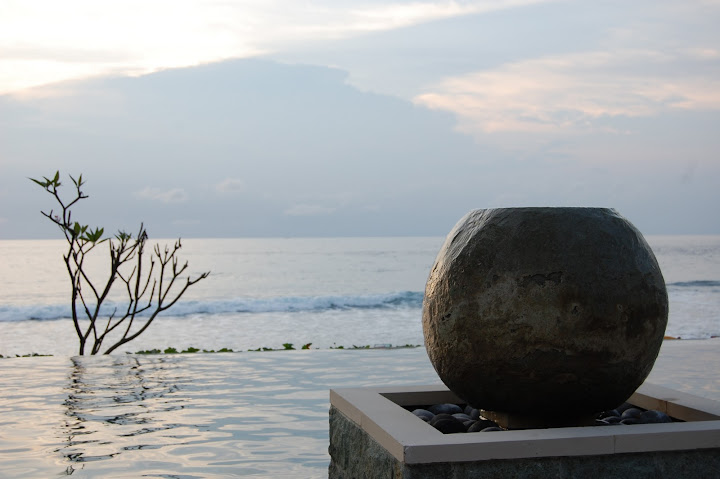 |
| Sunset in Lombok |
 |
| The beach. |
 |
| The hotel grounds, as seen from our balcony. |
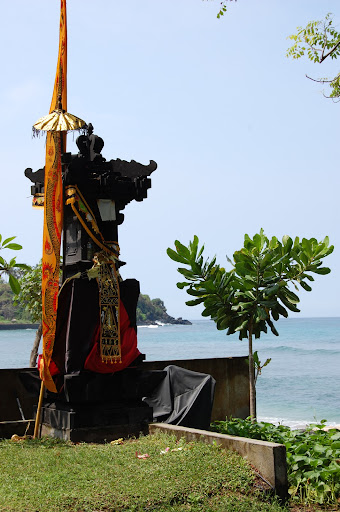 |
| Hindu shrine at the edge of the compound. |
 |
| The cow and football match next door. |
07 February 2011
A Wing and a Prayer
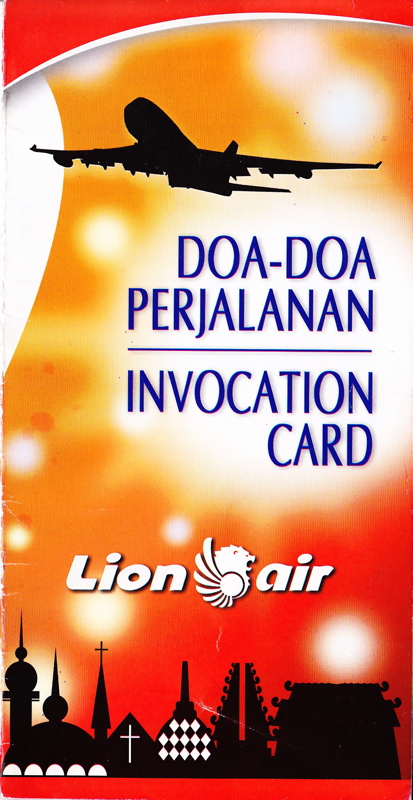 |
| We would now like to ask all passengers to please fasten their seat belts and beg for mercy from the deity of your choosing. |
The Passengers returned yesterday from a long weekend on the Indonesian island of Lombok. The Chinese New Year holiday gave us five days away from Singapore in a place south of the equator and just on the earthly side of paradise. We will post some pictures in the coming weeks. However, to get to Lombok we flew through Jakarta on Lion Air, an Indonesian carrier previously unknown to me.
 |
| A religious pick-n-mix. |
I am happy to report that service on Lion Air was safe and efficient, consistent with many budget airlines, though not as shiny as AirAsia or Easyjet. The surest sign that we had left the plush world of Singapore and its pampered flagship airline: the invocation card in the seatback pocket. The card carries a list of prayers that passengers might want to say before take-off. Invocations are available for Muslims (Indonesia's largest religious group), Protestants, Catholics, Hindus, Buddhists, and Confucians. Our Jewish traveling companions had to make up their own divine petitions.
 |
| Something for the rest of Asia. |
Click on the images of the invocation card for larger pictures of the prayers. It's kind of like a Rosetta Stone with prayers repeated in several languages, including English. When pronouncing written Bahasa Indonesia say all the letters. It's a relatively straightforward and pleasing language. Khonghucu, the last type of prayer listed, should be translated to English as Confucianism. Notice also that no one bothered to write the Confucian prayer in Chinese characters. It's a pamphlet of reassurance with only modestly reassuring execution. The one in my seatback pocket was torn so I took it as my excuse to disobey that "Mohon kartu ini jangan di bawa pulang" badge.
29 September 2010
Tokyo Food
.jpg) |
| A snack package of what appears to be hazelnuts in a Tokyo mini-mart. |
The Passengers ate all sorts of goodness in Tokyo. The Japanese take their food seriously in the same manner as do the French with serious refinement of standardized age-old recipes. We didn't suffer a bad meal once during our travels. Here are some highlights, though they exclude our early morning sushi adventure. That will be a separate post.
.jpg) |
| Ramen noodles with all the fixings. |
We had ramen one evening at a small restaurant not far from our ryokan. Diners are supposed to choose their dishes from a vending machine outside the front door. After the customer pays money in, the machine spits out a ticket for his order, and he brings it inside the restaurant. We tried our very best to match the Japanese labels on the selection buttons with the pictures in the window. Finally we gave up, and we were kindly greeted inside with an English menu. This bowl of ramen was as big as my head. I could barely get through half of it. Passenger H unwisely had her own bowl, too, which by the time she quit looked like she only managed to pick out the seaweed, the half-boild egg, and two pieces of scrumptious fatty pork. The yummy noodles are underneath a big pile of extras that also includes corn, bamboo shoots, and bean sprouts. I think we paid JPY 950 per bowl (USD 11.25/GBP 7.10). More dishes after the jump. Click below left to keep reading.
28 September 2010
Beware the Trains
 |
| Sign in the stairwell at Iriya Station in Tokyo. |
Tee hee. The Tokyo Metro trains have wind.
19 July 2010
Existential Evening Plans

Screen grab from an online reservation form for a Tokyo ryokan.
The Passengers are planning a trip to Japan next month, and I am doing my best to hunt down a traditional Japanese bed-and-breakfast, or ryokan, for our stay. These places sometimes also serve dinner to visitors so when I entered our meal preferences on the enquiry form above I was faced with a startling choice: large, medium, small, existential. Click the image for a detailed view.
09 June 2010
Homegrown Fashion | hansel
.jpg)
Summer has arrived here in our tropical city state, which means the advent of the Great Singapore Sale, an event aimed at attracting shoppers from around the region. Mom-and-pop shops and brand-name luxury retailers alike roll out the offers during these months. The Passengers have already taken part this weekend, stopping by the boutique of local label hansel (sound alert).
.jpg)
Thoughtfully bespectacled Singaporean Jo Soh started hansel, named after her Jack Russel terrier, in 2003 and has been growing and maturing the brand ever since. The collections she puts forth often follow playful themes, like "Robot Girl" or "Me & My Camel," with equally whimsical pieces. The most recent line goes under the title "Paper Dolly."
.jpg)
Paperdoll short sleeved cardigan. Notice the ceramic pin of the cat's-eye glasses that have become one of Jo Soh's calling cards.
Jo Soh herself drew the cover for the promotional booklet, shown above, and the entire collection follows the principles of this theme. These garments were seemingly conceived as two-dimensional cutouts to display in front of a model. Now, the realized products are structured for real ladies, even ones who are not paper thin, but details such as collars and buttons have been expressed only within the knit. Pockets that do function are not hidden but placed as fabric squares on the front of dresses.
.jpg)
Triple bow babydoll knit dress
The theme has not prevented Ms. Jo from attending to the reverse sides of her pieces. The dress pictured above keeps most of its eye-catching structuring behind the shoulders, but those bows, an elemental part of dress-up games here in grown-up colors, have flatten profiles that keep close to the body.
.jpg)
Paperdoll knit dress
All the items shown here use the black-and-white palette that has dominated past hansel collections, probably a reflection of the designer's skills with pen and ink. The Paper Dolly offerings do not break that trend, though the line includes a worthwhile dress in vivid red. For pictures of the rest of the collection visit the label's online shop. For more on Jo Soh and her retro personal taste, visit her blog.
30 May 2010
Returning

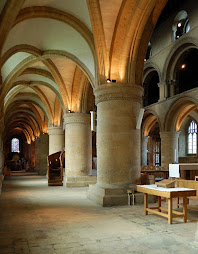
This post needed a picture so here is the view from underneath the crossing tower of York Minster.
I have been away from the blog for awhile so that I could write some real academic prose. More recently, the Passengers have been away from Singapore for awhile thanks to visitors and visits. We have managed to fit in Indonesia, Britain, America, and Britain once more. Half of us are again in Singapore because work can't wait, but we plan to be reunited soon. Fortunately, the time away has been refreshing, productive, and remarkably unencumbered by volcanic activity. Hopefully, more posts will follow this one, but actual schoolwork, like simmering volcanoes, remains a credible threat.
22 January 2010
Holiday Villas and Tanjung Rhu - Langkawi
.jpg)
The Sari Village Villas on the southwest shores of Langkawi.
The Passengers have been off the grid for awhile. The holidays were great for us, and we had wonderful friends visiting us over the New Year. Part of our time together included a trip to Langkawi, the Malaysian resort island. We had a great villa overlooking the Andaman Sea, complete with a breezy veranda.
.jpg)
The view out to sea from our villa.
.jpg)
Looking back from the cove.
One of our days was spent on the north end of the island at the beach of Tanjung Rhu, where the Four Seasons has set up a resort. It's a gorgeous setting and a luxurious looking venue. >> Follow the link below left to dig the view.
15 December 2009
Doors - Bali
.jpg)
This gate includes the Bahasa greeting "Selamat Datang" or "welcome."
People in Bali traditionally live in a family enclosure called a kampong (translated elsewhere in Bahasa-speaking regions as "village"). The compounds include numerous buildings for sleeping and cooking and farming, and though extended families often live together, they can spread out inside across multiple houses. The Hindu heritage of Bali means that each kampong contains any number of shrines including a seat for a deity beside the principal entrance and usually a small sacred precinct inside. Additionally, small offerings are placed daily in front of the doors of individual buildings. Here are some of the elaborate doorways that we saw around Ubud during our holiday. Click the link at the bottom left to see all the pictures.
.jpg)
Many kampong entrances have been modified to accommodate Bali's ubiquitous motorbikes. A Chinese-inspired alternative to the more popular chair-style shrines can be seen at left.
.jpg)
A kampong portal wedged between shops along the road.
16 November 2009
Bound for Bangkok
The Passengers need some more stamps in their passports. They are off to Thailand for 5 days in Bangkok. Send them an email (address on the right-hand sidebar) with any suggestions for sights to see.
04 September 2009
Lantau Buddha, Hong Kong
 All is still crazy in Passenger Land. We landed yesterday at Heathrow for about 10 days of R&R at H's family home. While she sleeps off the flight and the stress of closing down our New York apartment, I will provide more belated images from Hong Kong.
The Passengers ventured off Hong Kong Island on a journey to the Po Lin monastery on Lantau, one of the many islands in the Pearl River Delta within the Hong Kong Special Administrative Region. Despite the July heat and soaring hills, the journey was not difficult thanks to a load of technological wizardy. The Tung Chung terminus of the rapid, efficient MTR brings visitors to the brand-new Ngong Ping cable car.


The gondolas wind up and over a sweeping landscape of rugged, iconic hills rising out of the South China Sea. I would love to come back with hiking boots and a picnic for another trip. The ride brings thousands of tourists and locals up to a recreated Chinese village, built by the cable car company and filled with mulitmedia exhibits, souvenir stands, and a Starbucks. The Po Lin monastery nearby hosts the real attraction: a 112-foot bronze sculpture of the Buddha seated on a lotus throne. This is not an historical attraction. The statue was finished in 1993, and the two locations enjoy a mutualistic, capitalist relationship. The monastery welcomes devotees and lures pilgrims with its gigantic statue, while the Ngong Ping provides spectacular transportation and attends to visitors' more base desires with tchotchkes and gelato in the village. Win-win.
 Weekenders use parasols to ward off the sun as they walk from the village to the monastery.
 Warning: crowds and stairs ahead. The flag of Hong Kong SAR appears at left.
 A statue of a devotee making an offering.
 The walkways around the Buddha statue provide stunning views of the South China Sea. High-speed ferries can be seen streaking west to Macau. The former Portugese trading post is now a gambling/party mecca.
13 August 2009
Man Mo Temple, Hong Kong
 The 160-year old temple has resisted the general compulsion of Hong Kong to build skyward.
One of our stops during the long weekend in Hong Kong was the Man Mo temple on Hollywood road. The building was erected in 1847 and stands as a lonely holdout within the city’s vertical density. The temple honors the gods “Man,” and “Mo,” two deified kings. The amalgamated name exemplifies the playful and dualistic devices that punctuate Chinese names and superstitions. Literally these two words mean “civil” and “martial,” respectively.
 Offerings of incense contribute to interior's air of ceremony.
 Most of the sacred space has been decorated in red, an auspicious color in Chinese beliefs.
 One of a pair of animal sculptures flanking the incense burner before the gods' images.
Subscribe to:
Posts (Atom)




.jpg)