Showing posts with label Indonesia. Show all posts

19 November 2011

Lion Air in the News

"We make people fly," and Lion Air flies the Boeing 747 between Jakarta and Jeddah, Saudi Arabia.
More than six months ago this blog had a post about the Indonesian airline Lion Air. The company is now a little bit better known in the United States this week after putting in a massive order for 230 Boeing aircraft. The airline was started in 1999 by travel agent Rusdi Kirana and his brother. They are planning to expand their route map all over Southeast and East Asia:
The once little-known Indonesian airline says it is planning to buy 230 planes from Boeing Co. The bill — with a list price of $21.7 billion — is to be paid over 12 years though bank financing.
Dozens of airlines have emerged in Indonesia since it deregulated its aviation industry in the 1990s, making air travel affordable for the first time for many across the sprawling island nation of 240 million, and luring passengers away from ferries and trains.

05 March 2011

Indonesian Adventures

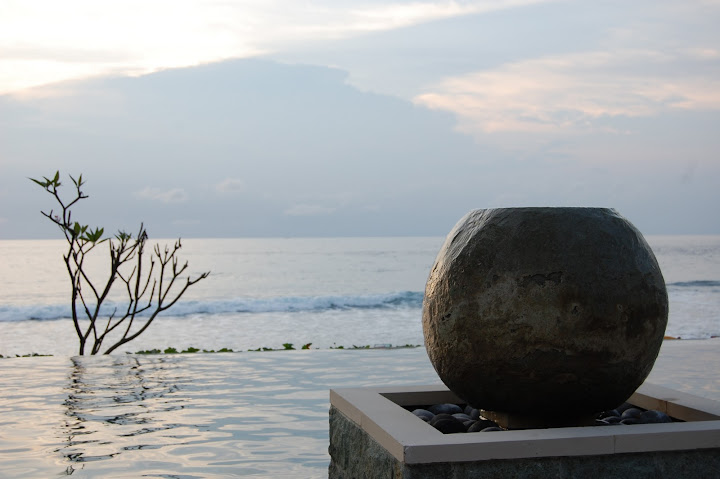
Sunset in Lombok
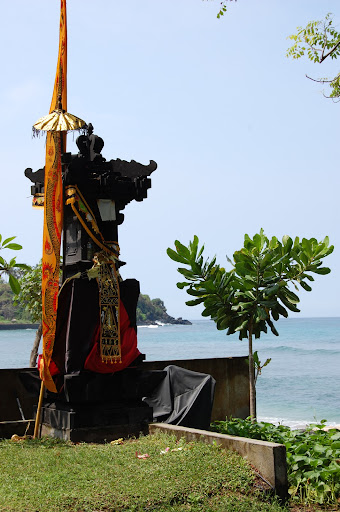
I told you The Passengers took a long weekend in Indonesia over the Chinese New Year holiday. We went to Lombok, the next island east of Bali, and one that still has some of Bali's Hindu traditions. We traveled with another couple and stayed at a fabulous resort called Qunci Villas. Here are a few glimpses of the place.

The beach.
The hotel grounds, as seen from our balcony.
Hindu shrine at the edge of the compound.
The cow and football match next door.

07 February 2011

A Wing and a Prayer

We would now like to ask all passengers to please fasten their seat belts and beg for mercy from the deity of your choosing.
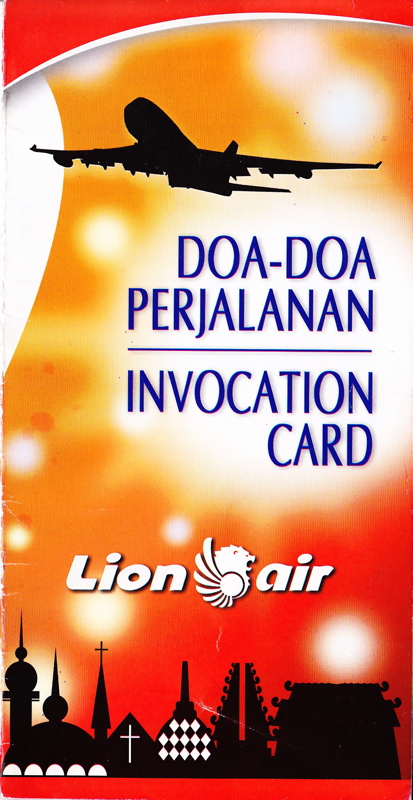
The Passengers returned yesterday from a long weekend on the Indonesian island of Lombok. The Chinese New Year holiday gave us five days away from Singapore in a place south of the equator and just on the earthly side of paradise. We will post some pictures in the coming weeks. However, to get to Lombok we flew through Jakarta on Lion Air, an Indonesian carrier previously unknown to me.

A religious pick-n-mix.
I am happy to report that service on Lion Air was safe and efficient, consistent with many budget airlines, though not as shiny as AirAsia or Easyjet. The surest sign that we had left the plush world of Singapore and its pampered flagship airline: the invocation card in the seatback pocket. The card carries a list of prayers that passengers might want to say before take-off. Invocations are available for Muslims (Indonesia's largest religious group), Protestants, Catholics, Hindus, Buddhists, and Confucians. Our Jewish traveling companions had to make up their own divine petitions.

Something for the rest of Asia.
Click on the images of the invocation card for larger pictures of the prayers. It's  kind of like a Rosetta Stone with prayers repeated in several languages, including English. When pronouncing written Bahasa Indonesia say all the letters. It's a relatively straightforward and pleasing language. Khonghucu, the last type of prayer listed, should be translated to English as Confucianism. Notice also that no one bothered to write the Confucian prayer in Chinese characters. It's a pamphlet of reassurance with only modestly reassuring execution. The one in my seatback pocket was torn so I took it as my excuse to disobey that "Mohon kartu ini jangan di bawa pulang" badge.

11 January 2011

Keeping it Clean Online in Southeast Asia

MICA Minster Lui Tuck Yew. (Image: Straits Times)
The Minister of Information, Communications and the Arts in Singapore said today that the internet is too expansive for the Singaporean government to block viewers from accessing all undesirable content online.  However, internet service providers (ISPs) in Singapore are required by the MICA to exclude users from 100 websites as "a symbolic statement of our community's stand on harmful and undesirable content on the Internet."  The ministry uses censorship in pursuit of its rather milquetoast stated goals "to nurture, amongst Singaporeans, a deep passion for the country, and to inspire Singaporeans to explore, take pride in, and celebrate our identity."  Of course, these measures don't come close to censorship practices in China, where the government recently boasted that in 2010  they blocked 60,000 websites filled with obscenity and pornography, a category that includes political satire.

Men in Jakarta, Indonesia, checking their smartphones. (Image: Yahoo! News file photo)
In similar news, the majority Muslim nation of Indonesia announced today that it has won concessions from with the makers of Blackberry smartphones to keep pornography off the popular handheld devices.  The Communication and Information Technology Minister in that country has given Blackberry manufacturer Research in Motion two weeks to placate the ministry.   The Minster baldly stated, "If in the next two weeks, RIM fails to comply with the order by January 21, we will revoke its permit." The encrypted and unfettered connectivity provided by RIM's addictive business gadget drew scrutiny in 2010 from Indonesia and the governments of Saudi Arabia, India, and the UAE.

15 December 2009

Doors - Bali


This gate includes the Bahasa greeting "Selamat Datang" or "welcome."

People in Bali traditionally live in a family enclosure called a kampong (translated elsewhere in Bahasa-speaking regions as "village").  The compounds include numerous buildings for sleeping and cooking and farming, and though extended families often live together, they can spread out inside across multiple houses.  The Hindu heritage of Bali means that each kampong contains any number of shrines including a seat for a deity beside the principal entrance and usually a small sacred precinct inside.  Additionally, small offerings are placed daily in front of the doors of individual buildings. Here are some of the elaborate doorways that we saw around Ubud during our holiday.  Click the link at the bottom left to see all the pictures.


Many kampong entrances have been modified to accommodate Bali's ubiquitous motorbikes. A Chinese-inspired alternative to the more popular chair-style shrines can be seen at left.


A kampong portal wedged between shops along the road.


09 December 2009

Champuan Ridge - Bali


The forested interior of Bali, Indonesia.
The Passengers are returned from a weekend on the island paradise of Bali.  This was our first trip south of the equator and the weekend had numerous other highlights, like surfing lessons and big cocktails at Naughty Nuri's. However, we especially enjoyed seeing the interior and countryside of the island around the artsy hangout of Ubud.  Here are some images from our hike along Champuan Ridge and around the villages nearby.  There's lots to see so this post has been broken into two pieces.  Click the link at the bottom left of this entry to look at the rest of the pictures.


Atop Champuan Ridge.


Bringing down the stalks from the ridge.


03 December 2009

Shophouse Living


The view from the entrance to the converted shophouse home featured in this week's "Great Homes & Destinations." The high ceilings, whirring fan, and indoor garden help moderate the tropical heat. Image from the New York Times.

The New York Times today shows off a domicile in Singapore in this week's "Great Homes" feature. The piece tells of two pretty young management consultants (jealous? me?) outfitting a classic shophouse with modern designs and local materials. The article taught me that Dahlia Gallery has great furniture offerings and that bespoke hardwood furniture is terribly cheap in Indonesia.

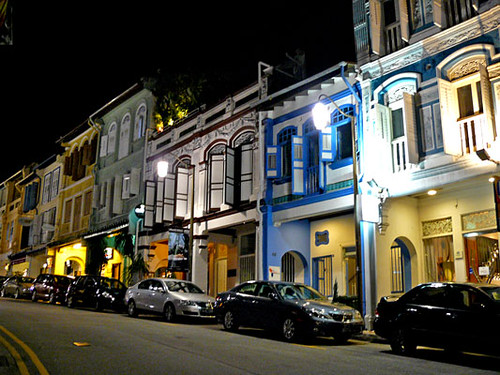
The shophouse facade; note the use of European-inspired plastered ornament. More images from the NYT article here.

Shophouses are an architectural distinctive of Southeast Asia. The houses are built as a series of narrow, contiguous properties. A shophouse is typically two or three stories tall with the ground level dedicated for commercial use and the upstairs given over to accommodation. The business level recedes from the street, creating a sheltered walkway along a row of adjacent shops. Most are ornamented with versions of classical pilasters, bold verticals against the horizontal structures, between the units or beside the shuttered windows. Often each house displays its own color scheme of contrasting colors, a convention that puts on display the riotous palette favored by the Peranakan merchants that prospered in this region.

Today as Singapore has urbanized, most shophouses have been converted to single-use buildings, either as high-end single-family homes or as locations dedicated to business. As houses they carry many of the romantic associations New Yorkers feel towards brownstones or San Franciscans do towards row houses. So shophouses can be hard to find at a reasonable price. The romance has also prompted commercial development of shophouses for upscale boutiques, like Club St/Ann Siang Hill. Unfortunately, ersatz shophouses - lined up, canopied over, and air-conditioned - form the main structures of the monstrous Clarke Quay development.

The shophouses along Club Street host arty shops, international fashion brands, swish offices, trendy restaurants, and even a few of the longstanding Chinese clan associations that gave the road its name. Leone Farbre has more photos on Flickr.

The strange canopies that allow visitors to Clarke Quay to experience air-conditioning whilst still outside. Image from the materials firm Macalloy's website.

08 June 2009

Been to Bintan

The Passengers spent this weekend relaxing on the island of Bintan. Actually, we whiled away two days in a cabana upon Singapore’s tourism beachhead in Indonesia. The island is a favorite getaway spot for urbanites looking for a tropical round of golf or quiet beaches away from the maritime parking lot that mars the sea view from East Coast Park. The ferry only takes an hour to cross the Singapore Strait and deposit weekenders among idyllic scenery and tropical breezes. Visitors frolic in a nearly closed, isolated system. When booking our getaway, the ferry website asked to know our resort. Then, upon disembarking from the ferry, we were loaded onto a shuttle bus at the terminal and whisked off to our resort. When it came time to leave, the resort completed our ferry check-in and handed us boarding passes before we caught the bus back to the terminal.

In conclusion, I submit photographic proof that we accomplished our plans for some serious sloth. We didn’t leave the comfort of the charming, thatched Mayang Sari resort, despite the availability of other inter-resort shuttle buses, so I will not pretend that our experience remotely approached the everyday life of Indonesians. I do hope that the stream of visitors benefits everyone on Bintan.

The main building and reception area.

Our own chalet, complete with front porch and high, breezy ceilings.

Expansive sands and warm, gentle waters.

Until next time, Bintan.