Showing posts with label sport. Show all posts

23 November 2011

USA Soccer: Getting Better


This blog has written previously about soccer/football/sepak bola (that last one in Malay) in the United States. The country's occasionally maligned MLS enjoyed a record 2011. The league continues to improve its stadia, and it found a receptive audience in the Pacific Northwest for new teams in Portland and Vancouver. The league is now third in the USA based on average attendance per game. They pipped the NBA and NHL with a mean 17,180 fans visiting each match. This is good news for development of the game in the USA and also an excuse for some quality highlights.


In other news the well paid LA Galaxy defeated Houston Dynamo for their third MLS cup on Sunday, and a few folks in the UK bothered to watch. Also Kasey Keller at 41 should still be sending his CV to European clubs.

07 December 2010

Singapore Turf Club, Gold Cup

The action along the final quarter of the Singapore Turf Club. 
A few weeks ago Passenger J went to the Singapore Turf Club to watch the ponies run for the Longines Singapore Gold Cup.  The venue is way up on the north end of the island but very accessible on the MRT.  As with so many places in Singapore, the venue is shiny and new and filled with all the latest amenities.

Tiers of tables in @Hibiscus overlooking the course.
We had a group of nearly a dozen gathered around a front row table at @Hibiscus, the mezzanine-level dining club.  We sat in the air-conditioning and watched the horses run in the warm mud on a rainy day.  The place offered adult beverages, but soft drinks and coffee were included in the ticket price, along with a big buffet of tasty Chinese and local dishes.  I plumped up on fried carrot cake, an honest-to-goodness savory dish here in Singapore.  Then, I had the apple crumble with vanilla sauce.

The starting barriers are wheeled into position for the 2200m Longines Singapore Gold Cup.
Oh, for the record, I am no good at backing a winner.  One win-place bet came good at 4-1, but I had to use that cash to repay the gracious organizer who purchased our tickets en masse.  The Turf Club is pretty good value provided one stays away from any high rolling antics. Admission, buffet, racing schedule, a S$5 betting voucher, and a tacky souvenir could all be had for one S$60 ticket (GBP 29/USD 46).  Not bad to watch a race meet with a S$1,350,000 (GBP 657,000/USD 1,037,000) stake. Actually for just S$3, payable with the same ez-link card that works for the MRT, one can watch on the non-air-conditioned lower level. Spend S$7 and one can sit in the air-con cool of the upper grandstand. Risky Business came on late and ran away from the Gold Cup field. 

More photos after the jump; click below left to see the parade ring.

27 September 2010

Singapore Grand Prix

The Singapore Flyer stands above the race course Sunday night beside the newly completed Marina Bay Sands Casino
 The Passengers watched last night's 2010 SingTel Singapore Grand Prix from an apartment office perched high above Marina Bay.  From our hosts' festive eyrie we had a commanding view of about half of the street circuit.  In the photo above the Formula One cars start underneath the Singapore Flyer ferris wheel, which hosted the pit lane, and return there after zooming past the stands of the National Stadium overlooking the water.  The photo below shows the circuit at left running between the government buildings and the dark, grassy padang.  The drivers then reemerge into view at the lowest part of the illumined track, where they make a sharp turn beside the Fullerton Hotel before racing across the straight along the bridge and past the Esplanade theatres (those shiny Durian-shaped buildings).  I tried to post photos of good quality.  Click them for a larger view.

The Marina Bay Circuit illuminated for the 2010 SingTel Singapore Grand Prix
The action was loud even from our vantage sixty-eight floors above the water.  The rain held off all day, despite a few dark, overcast moments, and racing fans were rewarded with exciting competition.  Ferrari driver and pole sitter Fernando Alonso carried the day with Sebastian Vettel and Mark Webber right behind.  This was the third running of the Singapore Grand Prix, and the event is expected to become a fixture of the Formula One calendar for some time, though an extension has not been announced.

Japanese Baseball

Hiroshima Carp batting against Yomiuri Giants at the Tokyodome.
Now an overdue entry on Japan.  During our time in Tokyo the Passengers took the opportunity to see a baseball game at the Tokyodome: Hiroshima Carp vs. Yomiuri Giants.  The Giants are Japan's equivalent to the New York Yankees, the nation's most storied and successful team, and they turned in a very good performance during our Sunday afternoon visit.  Starting pitcher Asai pitched 7+ innings of shutout ball, and the offense put in two home runs.  The quality of play was every bit as good as MLB in the US and Canada. The tickets I bought online cost about as much, or even a little less, than an MLB game in a major American city, too.

The right-field stands lead the cheers for the home team.  They rolled out this banner in the middle of the seventh inning.
None of that was too surprising.  What I really wanted to experience was the atmosphere of professional baseball in another country.  I was not disappointed.  The fans of both teams proved incredibly dedicated with organized cheers for their batters.  The Carp brought in a host of supporters wearing red in the left-field stands.  The Giants had the whole stadium on their side, all the fans chanted while waving around bright orange towels over their heads after scoring runs, but the right-field seats hosted the die hard supporters that led the cheers.  They even had two large flags waving in tandem.

In the foreground ladies sell beer and snack food.  Cheerleaders dance on the field.
Additional entertainment came from the ladies.  Beer and snacks were sold throughout the game by young women wearing brightly colored kit.  Beer was dispensed from pony kegs in insulated bags hauled up and down the stands.  All the usual staples could be found in the Tokyo Dome: beer, peanuts, soft drinks, cotton candy.  However, the concession windows offered bento boxes and outrageous ice creams.

The team also had cheerleaders dancing between innings, sometimes with the Giants' family of orange furry mascots.  After a Giants home run the dancers stream onto the field for a celebratory routine while one of the troop jumps up and down behind home plate waving a souvenir stuffed animal.  The Giants players all come out of the dugout and form a line to politely congratulate the batter after he circles the bases.  Once the last runner crosses home plate he is given the stuffed animal, shakes hands with everyone in the receiving line, and then tosses the orange plush toy into the crowd.  The whole affair seems designed to spread the success around to everyone.

Reporters and onlookers stream onto the field for the post-game awards.
The post-game press conference was another unusual moment because it takes place on the field with a horde of press reporters and photographers.  As seen in the pictures, the cheerleaders and mascots flank the stage as the day's outstanding player is awarded the game ball, which deservedly went to pitcher Asai.  He makes a few comments into the microphone for the benefit of the crowd and the media.  For some reason the onlookers included a giant Pikachu Pokemon.

There are a couple more pictures after the jump.  Click the link below left to view them.

25 September 2010

Singapore Grand Prix Sunday

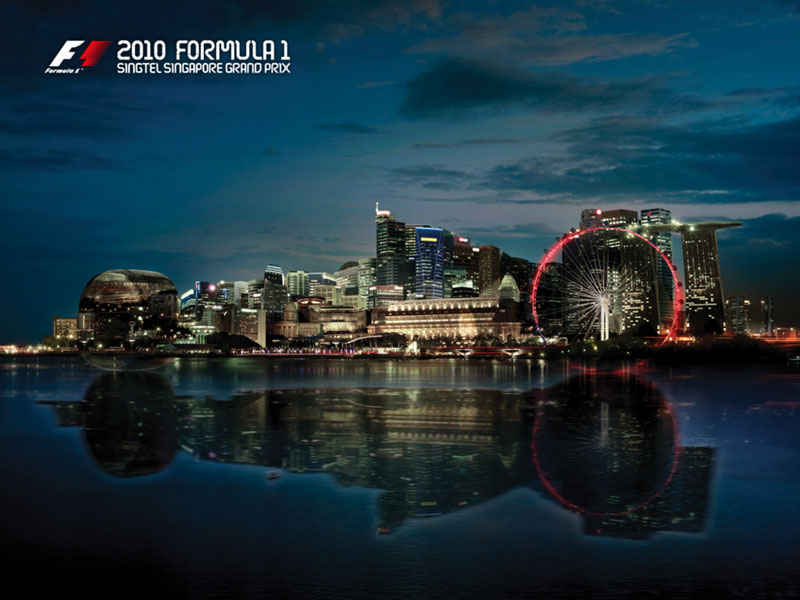
The skyline is not quite right, but it's a good overall impression.
Practice runs have already begun on the Marina Bay circuit ahead of this week's Formula One race in Singapore.  The contest is a true grand-prix style race on the downtown streets of the city,  called the Marina Bay circuit: around the new casino, under the giant Singapore Flyer ferris wheel, along the Padang parade grounds and its government buildings, and beside the high rise office towers of the Central Business District.  The twist?  The race begins at night, 8:00 PM local time, which puts it in the traditional  Sunday afternoon motorsport timeslot in Europe: 1:00 PM in Britain, 2:00 PM on most of the Continent.  The BBC has a slideshow of the preparations here.  

The Singapore race is happening amid a big-time title chase featuring some of Formula One's most recognizable drivers. Unfortunately, we have had afternoon rain showers every day this week, including now as I write.  Though the evenings have been dry, the tropical humidity lets all that moisture linger and is creating tough conditions on the racetrack.

The Passengers plan to watch the event tomorrow from a friend's downtown apartment that happens to overlook part of the racing circuit.  At the very least it will be loud.

18 September 2010

Excellent mascots

The Passengers are enjoying a weekend in fabulous Hong Kong. Last night we propped up the bar at a basement members club. Here is an extract from the best conversation of the night:

Passenger H & Passenger J are introduced to another patron of the establishment.
Pleasant Stranger (to Passenger J): So what do you do?
Passenger J: I'm an Art Historian.
Pleasant Stranger: That's great! I went to Art School!
Passenger J (interested): Oh really! Where?
Pleasant Stranger: Rhode Island School of Design.
Passenger H (excitedly, over J's shoulder): Go Nads!

For those of you who are not well versed in the mascots of university ice hockey teams, the RISD team is called the Nads.  Passenger H has been waiting for the opportunity to work that one into  a conversation for a very long time and was ready when the moment came.

31 July 2010

Generational Resignations

 It wasn't a pretty line across the scoreboard of Kaufman Stadium. Image from the Kansas City Star.

My dad and I had to pass each other condolences after the Kansas City Royals lost 19-1 to the Minnesota Twins on Monday.  My parents had the misfortune of choosing that evening to go to the ballpark.  This is what bonds fathers and sons in America: the shared joys and sufferings of baseball.  Somewhere a man and a boy marveled at Joe Mauer's 5-hit, 7-RBI performance.  We shrugged our shoulders and remembered that the Royals haven't enjoyed a winning season since 2003.

A love for baseball must be instilled in a child early.  The video below salutes fathers committed to raising their kids right. 

22 January 2010

(Winter) Olympic Dreams


Professional blow-hard Stephen Colbert is ready to race.

Comedy Central's "right-wing" personality Stephen Colbert has thrown his weight behind the US speedskating team ahead of the 2010 Winter Olympics.  For those outside the US and not aware of the Colbert Nation, Stephen plays a bloviating pundit who hosts a news/commentary show airing directly after Jon Stewart's "Daily Show," where he earned his comedy stripes. "The Colbert Report" (don't pronounce the t's) specializes in hyperventilating obscurantist diatribes à la televised rabble-rousers   Sean Hannity, Lou Dobbs, or Bill O'Reilly.  The mockery extends even to aesthetics with a set  laden with flags, eagles, and red-white-and-blue bunting -- all surrounding a huge desk in the shape of a "C."

Colbert manifests the sort of personality cult that accompanies such commentators by exhorting his followers to attach his name to whatever they can. Fans have responded. His nomenclature empire now includes a water beetle and the undetermined solution to a mathematical problem.  Most famously, loyal voters made "Colbert" the name for a new wing scheduled for installation on the International Space Station.  NASA balked and instead invented a COLBERT acronym for an exercise treadmill in the station. >>Follow the link below left to read on.

11 December 2009

Hawkeye Style


Thank you, Deadspin, for posting this video to a wider audience.


College football, a sport of rivalry, pageantry, and not a little bit of id, concluded its regular season last weekend.  Now we await bowl season, a calendar of thirty-four arranged matches lousy with corporate sponsorship overlaying America's holiday calendar.  It all culminates on 7 January 2010 when Alabama and Texas play in the Citi BCS National Championship for the "Coaches' Trophy presented by Dr. Pepper."  The whole spectacle of college football with its marching bands, cheerleaders, and huge stadiums bedecked in partisan apparel only intensifies for these events.

All those trappings of competition might be symptomatic of unfortunate tribalistic fervor with disturbing resemblances to militant nationalism.  However, it should be remembered that many parts of America have embraced university teams because of a dearth of other amusements.  This would be especially true of many state schools.  Notice a pattern among many of these other top-ranked teams in addition to Alabama and Texas: Utah, Nebraska, Oklahoma State, West Virginia, and Iowa.  Most of these places are long on rural heritage and without a local professional team.  Too little  urban entertainment should help explain why aspiring rapper Notti Boy took the time to record the largely wholesome video above in support of his team, University of Iowa Hawkeyes.  It sounds like hip-hop in the Midwest has not changed much since the start of the decade. Imagine the even greater limitations of supporters for high achieving football squads at religious institutions like BYU (Brigham Young University, a Mormon college in Provo, Utah) and TCU (Texas Christian University in Fort Worth, TX).

Iowa and Georgia Tech play in the FedEx Orange Bowl on 5 January 2010.

25 November 2009

United Homeless Organization Revelations

One of the streetcorner tables where homeless or formerly homeless people ask passersby for donations to the United Homeless Organization. Photo from the New York Times.

On Monday the Attorney General for New York State Andrew M. Cuomo filed a lawsuit against the president and director of the United Homeless Organization alleging that the leaders used the charity's funds for personal expenses while doing little, if anything, to help the homeless in New York City. The organization has long maintained a visible presence in the city. Almost every day people on the Manhattan sidewalks pass by one of the folding tables draped in a distinctive red tablecloth with an empty water-cooler jug to collect money. The lawsuit alleges that the UHO president Stephen Riley and director Myra Walker used the charity's funds largely for personal expenses.

The details suggest a case of small-time crookery. This was not a racket that provided powerful people with the opportunity to unnecessarily fly business class on dubious business or to condemn large swaths of Brooklyn for a sports arena. As reported by the New York Times:
The expenses, the lawsuit said, included premium cable television service at Mr. Riley's apartment, restaurant meals; trips to Cleveland, Mr. Riley's hometown; and shopping purchases from GameStop, the Home Shopping Network, and the web site for Weight Watchers.
But the filing also shines a light on how those ubiquitous donation tables work. Each homeless or formerly homeless person who staffs a table pays the first $15 of donations back to the group for using their name and equipment. The rest is kept by the table's worker. Essentially UHO has been sanctioning begging on the city streets. The arrangement has been known since 2001, but it appears now that all those $15 fees collected by UHO have done little to provide any wider relief to those in need.

13 October 2009

USA Soccer: Now some Better News

Go Wiz!

Contrary to yesterday's post, soccer is not unappreciated and unnoticed in the United States. In fact, the world's most popular spectator sport has finally found itself a place in world's largest entertainment market. Of course, soccer is not about to usurp college football or Nascar or the NFL from the nation's sporting liturgy, but the nation has slowly and steadily created opportunities to attract and retain passionate fans.

The most important effort has been the creation of Major League Soccer (MLS) in 1996. Major investments in America's domestic league began with ten teams in 1996 as an effort to capitalize on the enthusiasm generated by the 1994 World Cup finals held in the United States. Rather than splash out on top European or Latin American players in hopes of attracting huge crowds, as the ill-fated North American Soccer League did in the 1970's, the initial investors agreed to tight-fisted salary caps. Moreover, for the sake of nurturing domestic talent, i.e. the national team, each club was limited to carrying only five foreign-born players.

The experiment has undergone a number of growing pains. At first, many of the teams competed in giant stadiums designed for American football. Though these established venues were happy to lease out space in the spring and summer months, their over-sized dimensions meant that even a great turnout of 20,000 fans would bring a stadium to maybe 25% capacity. Now many franchises have sought out smaller, more intimate venues on college campuses or minor-league ballparks. LA and Columbus even have soccer-specific stadia.

Crew Stadium in Columbus, OH, offers a more fitting soccer venue than the city's 100,000-seat Ohio Stadium, aka "The Horseshoe."

Those early optics were not helped by the 1990's American sports trend of nicknaming teams for concepts and non-plural nouns. This trend produced head-scratchers like Tampa Bay Lightning in the NHL, but MLS took it to another level: Columbus Crew, San Jose Clash, Tampa Bay Mutiny. Most of these clubs were stationed in growing cities with only modest experience in pro sports, but Kansas City should have known better than to call its club KC Wiz. The name may reference "The Wizard of Oz," but a crowd chanting, "Go Wiz!" won't really intimidate the opposition. The team hastily became the Wizards in November 1996; Dallas Burn are now simply FC Dallas, and San Jose plays as Earthquakes.

The name change for Dallas taps into the current MLS trend: burnishing a side's soccer bonafides by imitating established club names in Europe. Incremental expansion has brought Real Salt Lake, Houston Dynamo, Toronto FC, and soon Philadelphia Union. Los Angeles even has Club Deportivo Chivas USA, an American offshoot of the established Guadalajara club and the area's Spanish friendly counterweight to flash LA Galaxy.

Stuart Holden of Amigo Energy (Houston Dynamo) challenges Seth Stammler of Red Bull (New York Red Bulls). Photo by Mike Stobe for Getty, 16 May 2009.

For fourteen seasons MLS has declined to buy their way to the top of the US sporting scene and settled instead for organic growth. This patience has helped to manage expectations and build a loyal fan base. The most publicized MLS story, LA Galaxy's purchase of celebrity footballer David Beckham in 2007, stood as a clear exception to the overall business model. The first franchise owners may have included heavyweights from the NFL and NHL, like Anschutz Entertainment Group (AEG) and the late Lamar Hunt, but they ventured forth with a rather conservative, even European business model. Notice the choice to accept the dependable revenue of shirt sponsors. It might be a common practice worldwide, but none of the major television sports in America does that. MLS knew they were starting a league that couldn't outplay or outdraw the English Premiership or Serie A for viewers or players. Sustainability had to trump theater.

12 October 2009

USA Soccer: First the Bad News

Update added below...

Mexico is in. England is in. So is Italy, but Turkey is out, and Portugal is looking shaky. Saturday featured worldwide sporting excitement as the major European football (soccer) leagues paused their schedule for the penultimate game of the World Cup group qualifiers. The Americans had to travel to Central America and defeat Honduras if they wanted a place at next summer's World Cup finals in South Africa. But did anyone care in the USA?

Yesterday, the Passengers awoke early in Singapore to join some of my countrymen watching college football courtesy of new-fangled Slingbox technology. For all you Britons, college football is the Saturday ritual of autumn across the Atlantic that involves millions of people gathering in stadiums with seating for over 100,000 people to watch university students play (American) football. A college football Saturday features more than fifty games, but only about twenty really matter. To partake of this rite in Singapore, twelve hours ahead of New York, passionate alumni must choose between the afternoon games starting at midnight or the evening games that start at 8:00 AM Sunday morning. This week was the highly anticipated contest between Florida and Louisiana State, but we were Big Ten alumni so we cared more about Michigan vs. Iowa.

As we watched, we noted the results from the earlier European qualifiers that occasionally scrolled across the bottom of the screen, along with other college scores and listings for the baseball playoffs, but none of us knew what country USA was playing nor what the game meant for their chance to qualify. The second half of the match in Honduras was still going when the Michigan game finished so we decided to change channels and cheer for our country. Unfortunately, no station available to us was carrying the game. That's right, despite 300+ channels of cable television available to one Michigan household, not one station bothered to broadcast a major international soccer match.

UPDATE (14 October 2009): The difficulty in finding the USA vs. Honduras game on TV was abetted by the Honduras federation, which under FIFA rules holds the television rights as the home side, deciding to sell the US broadcast rights to a company which elected to show the game on an obscure closed-circuit broadcast. Similar, yet stranger, circumstances restricted the moot England qualifier in Ukraine to a pay-per-view, online-only event. However, both blackouts ultimately resulted from the calculations of major media outlets that the expense of buying television rights and altering established broadcast schedules would not garner the advertising revenues or ratings to justify airing a World Cup qualifier.